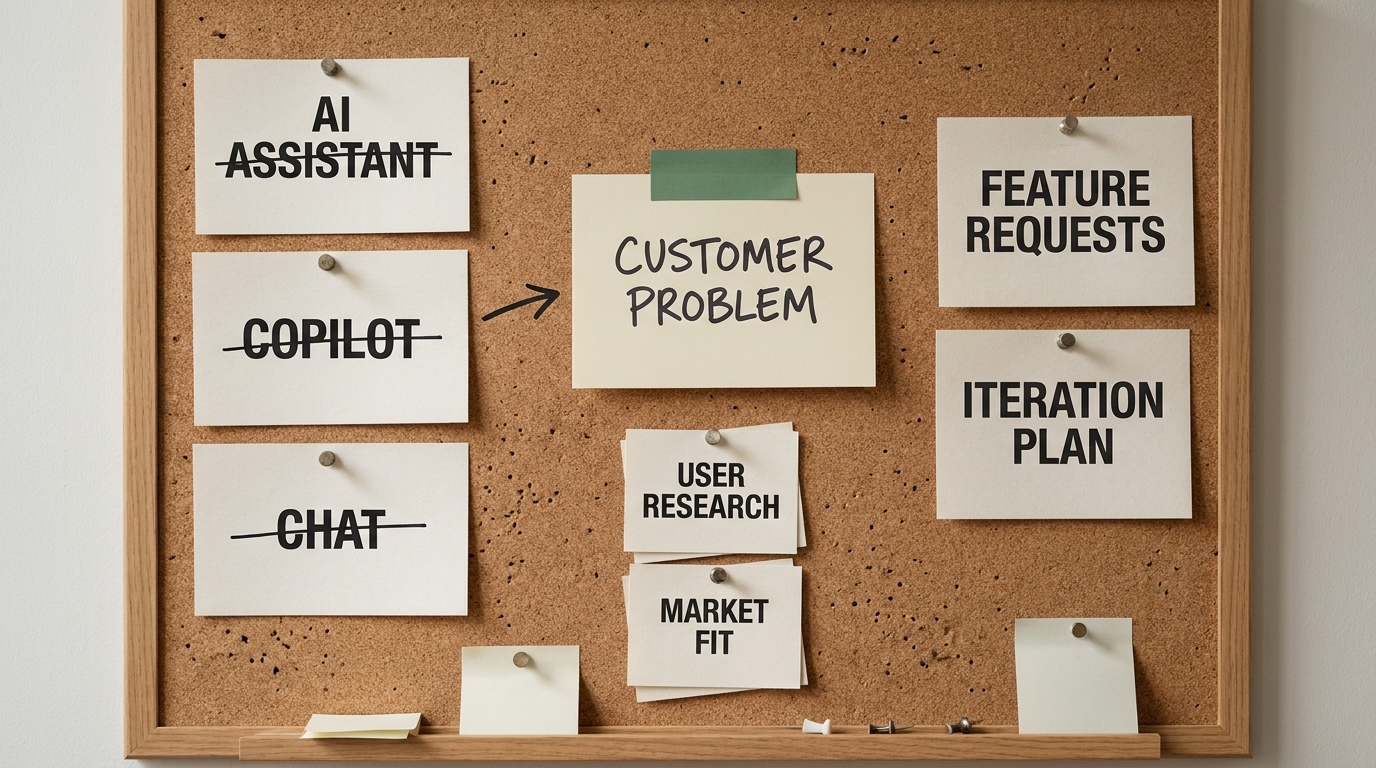

Six engineers on a team of eight did everything right with their AI tools. They wrote a short spec before prompting, fed the agent the repo conventions, read every generated line, and added tests. The other two pasted a ticket into the chat window and opened a pull request with whatever came back. Three months later, the defect log and the review queue both pointed at the same two names, and the six were spending their afternoons cleaning up after them.
The rollout plan assumed AI would close the gap between those two groups. It widened it. AI tools don't fix skill gaps. They amplify them.
In AI-assisted development, the team's output is capped by its least-trained engineer, because every step in the workflow feeds the next one. This article is about AI training for developers at the team level: why one untrained person breaks the chain, what that looks like in a real delivery pipeline, and the team-level standard that fixes it.
Before the failure modes, here is the target. A team where everyone meets the bar tends to look like this:
- Every engineer supplies the same baseline context to the AI tool: conventions, constraints, and the spec for the task.
- Nobody opens a pull request containing generated code they cannot explain line by line.
- Review rules for AI output are written down and applied the same way by everyone.
- The non-negotiable workflow steps, such as tests and spec updates, happen on every ticket, the messy ones included.
- New hires pair with a trained engineer before they work alone.
AI Amplifies the Skill Gaps You Already Have
The promise sold with AI coding tools is leveling: give everyone an assistant and the gap between your strongest and weakest engineers narrows. The research points the other way, and so does the review queue.
Google's DORA research program put it plainly in its 2025 State of AI-assisted Software Development report: AI acts as an amplifier. It magnifies the strengths of teams that already have good practices and the dysfunctions of teams that don't. The same logic holds inside a single team. An engineer with sharp judgment, clear context, and the habit of reading code critically gets real leverage from an AI tool. An engineer without those habits gets more plausible-looking code, faster, with the same blind spots at higher volume.
Speed perception makes this harder to see. In a 2025 randomized controlled trial, METR found that experienced open-source developers using AI tools took 19% longer to complete tasks, while believing they had been about 20% faster. If experienced engineers misjudge their own speed by that much, a less experienced engineer has even less chance of noticing when the tool is producing work that someone else will pay for later.
One clarification, because the phrase is ambiguous in search results: "training" here means training people to work with AI tools inside your workflow. It does not mean training or fine-tuning models.
AI-Driven Development Is a Chain, Not a Set of Individual Tools
Most leaders picture AI adoption as a set of personal tools. Each engineer has a license, each engineer gets faster. That picture is wrong, because AI-assisted development is a sequence where every output is the next step's input.
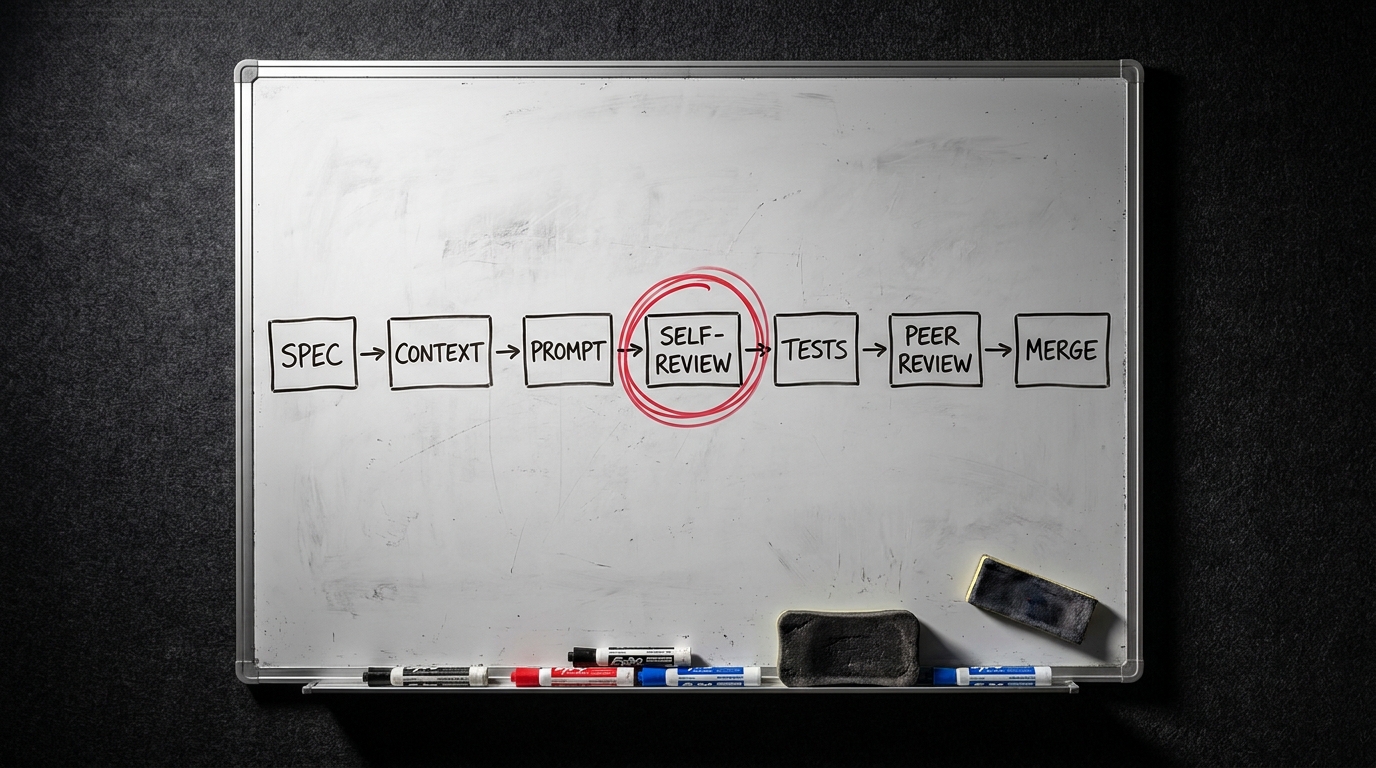
A typical chain looks like this:
- Task framing. A trained engineer turns the ticket into a clear spec with acceptance criteria before touching the AI tool.
- Context. They supply the conventions, architecture notes, and constraints the model cannot guess.
- Prompting and generation. They ask for a scoped change, not a whole feature in one shot.
- Self-review. They read the diff as if a stranger wrote it, because effectively one did.
- Tests. They write or verify tests for the generated logic.
- Peer review. A colleague reviews a PR that is small enough to actually review.
- Merge and release. CI, staging, and monitoring catch what review missed.
When one link is weak, the risk does not stay put. A vague spec produces vague code. Missing context produces code that ignores your conventions. Skipped self-review hands an unread diff to a peer reviewer who assumes the author already checked it. Each step downstream inherits the problem, and the cost of fixing it rises the further it travels.
That is why the chain is only as strong as its least-trained link. Six engineers doing every step well cannot compensate for the one whose PRs skip three of them, because their work lands in the same codebase, the same review queue, and the same release. Here is what that weak link actually looks like from a manager's chair.
Five Ways One Untrained Engineer Breaks the Pipeline
These are the patterns that show up most often in AI-assisted delivery teams. Each one has a signal a manager can spot without reading every PR.
Generated code merged without real review
The engineer accepts what the tool produced, skims it, and opens the PR. The reviewer sees clean formatting and passing CI and approves. Nobody has actually reasoned about the edge cases.
Signal: PR authors who struggle to answer "why does this branch exist?" in review comments. Large PRs approved in minutes.
Workflow steps quietly skipped
The team agreed on a spec file, a context file, and tests for every generated change. The untrained engineer skips the spec "because the ticket was simple" and skips tests "because the AI wrote them already."
Signal: tickets closed without the artifacts your workflow requires. Test coverage that drops in specific areas of the codebase.
Inconsistent prompts and context, inconsistent code
When each engineer prompts differently and supplies different context, the codebase starts to show it. One module uses your error-handling pattern. The module next to it uses whatever the model defaulted to. GitClear's 2024 analysis of 153 million changed lines of code found code churn on track to double compared with its pre-AI 2021 baseline, along with a rise in copy-pasted code. Inconsistent context is one of the ways that pattern gets into a single team's repo.
Signal: reviewers repeatedly leaving the same "we don't do it this way here" comments on one person's PRs.
Review load shifts onto your trained engineers
The trained engineers catch the problems. That is the good news. The bad news is that catching them turns into their job, and nobody wrote that into their goals.
Signal: a small number of senior names on most approvals, and their own ticket throughput dropping.
Defects surface late, in QA or production
Whatever review missed shows up later, where it costs more. Bugs from AI-generated code are often subtle: plausible logic that handles the happy path and gets the rest wrong.
Signal: post-merge defects that cluster around the same authors or the same AI-heavy modules.
Why Your Best Engineers Get Slower
Of the five failure modes, this is the one leadership sees last. Delivery dashboards show team throughput. They rarely show who is absorbing whose work.

When one or two engineers produce AI output that needs heavy correction, the trained engineers become reviewers and unofficial teachers for everyone else. Their own throughput drops. The team's average looks acceptable, so nobody asks why your strongest people seem busy but are shipping less. Over time, the engineers you can least afford to lose are the ones most likely to burn out on cleanup work.
The DORA research adds a system-level warning. Its 2024 report estimated that a 25% increase in AI adoption was associated with a 1.5% drop in delivery throughput and a 7.2% drop in delivery stability. Uneven skill across a team is one plausible mechanism behind that kind of result: more code enters the pipeline, but the capacity to verify it does not grow with it. If your engineers have AI tools and your delivery speed did not change , this is one of the first places to look. The fix starts with a standard.
Set a Baseline Every Engineer Must Meet
Start with a written standard. Course catalogs can wait. Individual courses teach someone to use a tool. A team baseline defines how your team uses it, so everyone's output can be trusted by everyone else.
A useful baseline covers four things:
- How to frame a task. What a spec must contain before any prompting starts: the goal, acceptance criteria, constraints, and what is out of scope.
- What context to supply. The shared files every engineer feeds the tool, such as coding conventions, architecture notes, and examples of the patterns you want repeated.
- Which steps are non-negotiable. Tests for generated logic, self-review before a PR, and updating the spec when the implementation changes.
- When not to use AI. Security-sensitive code, unfamiliar parts of the system the engineer cannot yet evaluate, and changes where the cost of a subtle error is high.
Keep it short, versioned, and in the repo, next to the code it governs. Shared prompt and context files belong there too, so improvements spread to the whole team instead of living in one engineer's chat history.
"Everyone" has to mean everyone. That includes the senior engineer who prefers not to use AI tools and the contractor who joined last month. A standard with exceptions is a suggestion.
Review Rules for AI-Generated Code
AI output needs its own review rules, because its failure modes are different. The code reads fluently and passes the checks it was generated to pass. Fluent code is exactly the kind reviewers wave through, so your rules have to account for that.
A starting set that works for most teams:
- The author owns every line. Before opening a PR, the author has read and can explain all generated code. "The AI wrote it" is not an answer in review.
- Declare AI-assisted changes. The PR description notes which parts were generated and what context was used, so reviewers know where to look harder.
- Tests are required for generated logic. Written or verified by the author, covering the edge cases as well as the happy path the model assumed.
- Size limits apply. AI makes it easy to produce a 1,500-line PR in an afternoon. Nobody can review that well. Set a limit and split larger changes.
- Reviewers can reject what the author cannot explain. This one rule does more than any tool to stop unreviewed generated code from merging.
These rules pair well with a clear definition of done for production-ready AI code and with shift-left testing that catches AI-generated bugs before they ship . The goal is the same in each case: move verification earlier, while it is still cheap.
Pair to Onboard, Then Check That "Trained" Is True
A baseline on paper changes nothing for the two engineers in the opening story. Two practices get them to it: pairing, and a definition of trained you can verify.
Pairing for onboarding. New hires and engineers who are behind on the workflow pair with a trained engineer on real tickets for a set period. First they watch the full chain: spec, context, prompt, self-review, tests. Then they drive while the trained engineer reviews. This transfers the habits that a course cannot teach, such as when to throw away a generated answer and start over, or how much context is enough. Budget it as onboarding time for both people, not a favor.
A definition of trained you can check. "They have a license and say they use it" is not a definition. Use observable criteria, signed off by the engineering manager or a tech lead:
| Criterion | How you verify it |
|---|---|
| Completed a set number of paired tickets using the team workflow | Pairing log or ticket history |
| Shipped PRs that passed review without AI-related rework | Review comments over the last few weeks |
| Can explain the context they supplied and why | A short walkthrough of a recent PR |
| Follows the review rules without prompting | PR descriptions and test coverage on their changes |
| Knows when not to use AI on a task | Discussion of a recent ticket where they chose not to |
Measure the gap at team level. Track a handful of signals over time rather than a single score: review turnaround, the share of PRs needing AI-related rework, defects found after merge, and the spread between your fastest and slowest engineers. If the spread narrows and post-merge defects fall, the chain is getting stronger. If one person stays an outlier, you know where the next pairing hours should go.
Train the Team as One Unit
Go back to the team of eight. The two engineers were never the real problem. The missing standard was.
An engineer who skips the spec and merges whatever the tool produced costs the team far more than their own slow tickets. They push risk onto every step that follows and work onto every colleague who has to catch it. So AI training for developers has to cover the whole team, with a shared baseline, review rules for AI output, pairing for onboarding, and a definition of trained that someone actually checks.
The hard part is capacity. The engineers who could set this up and run the pairing are usually the same ones already buried in review. If that sounds like your team, an embedded Fractional Agentic Team can write the baseline with you, run pairing on real tickets, and carry part of the review load while the rest of the team reaches the standard.