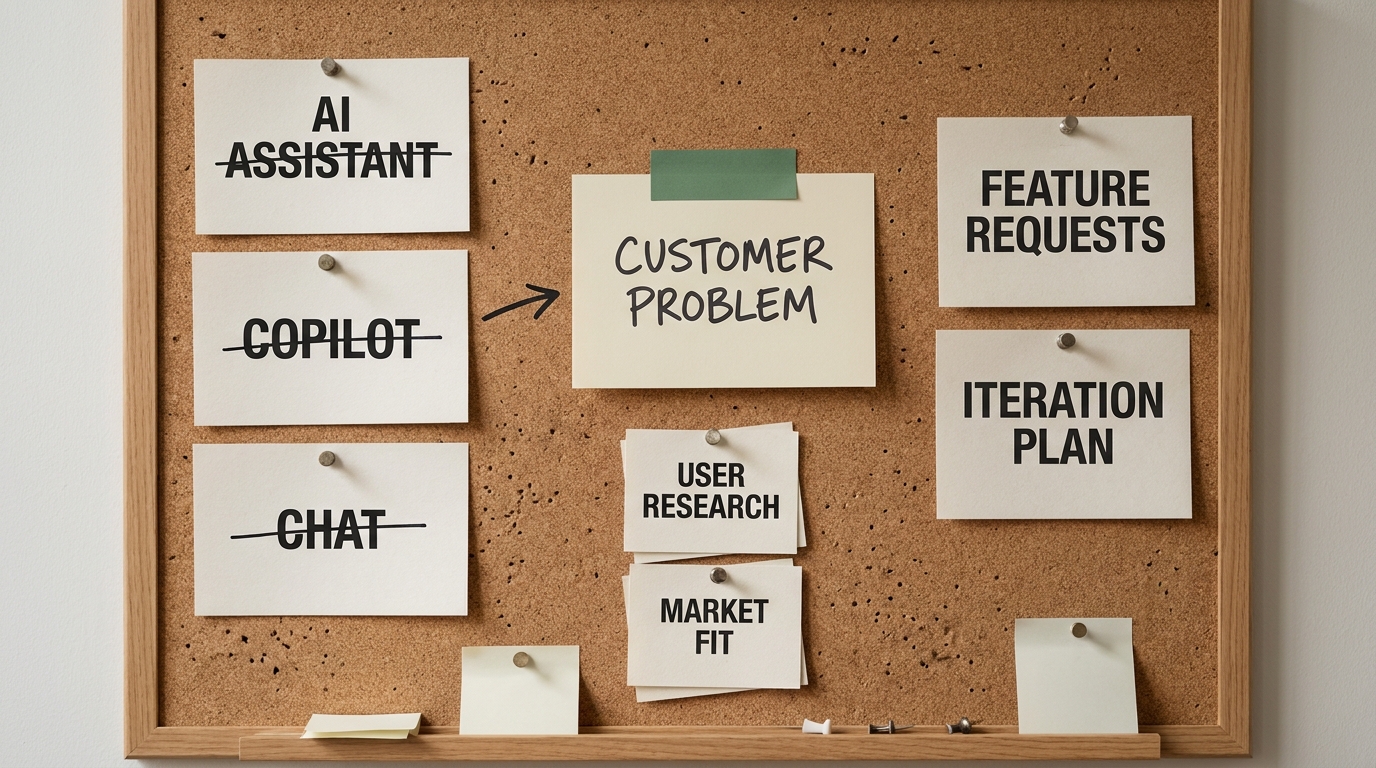

AI spending keeps climbing. The returns, for most companies, stay invisible. Pilots ship, demos land, and then someone on the board asks what moved in the actual numbers. The honest answer is usually "not much, not yet." That gap, between the money going out and the value coming back, is the real story of AI digital transformation right now. It is not a technology problem. It is an execution problem, which is the good news, because execution is something you can fix.
The companies pulling ahead are not the ones with the fattest model budgets. They are the ones that stopped bolting AI onto the work they already had and started rebuilding the work around what AI can now do. Sounds like a small distinction. It is the entire game.
What AI digital transformation actually is, and what it isn't
AI digital transformation means redesigning core workflows, decisions, and operating models around AI capabilities, instead of adding AI features to processes that otherwise stay exactly the same. It builds on the earlier wave of digital transformation, the move off analog and manual systems onto cloud, mobile, and data platforms. But the center of gravity shifts. Digital transformation put your operations onto software. AI transformation changes what that software decides and does on its own .
Why does the difference matter so much? Because most of the failures get it backwards. They treat AI as a layer of point features. A chatbot here. A summarization tool there. A copilot tucked into the document editor. Every feature is real, and every one delivers a thin slice of convenience. None of them changes how a process actually runs, so none of them ever shows up in cost, cycle time, or revenue.
I find it helps to picture a real transformation as a capability stack with four levels:
- Data. Clean, accessible, governed data is the precondition. Point AI at fragmented or untrusted data and you get fast, confident, wrong answers.
- Workflow. The sequence of steps that gets work done. This is where AI replaces a step, compresses several, or removes a handoff outright.
- Decisions. The judgment calls inside the workflow, where AI shifts from doing tasks to supporting or making choices. Forecasting demand. Scoring risk. Routing a case.
- Operating model. How teams, ownership, and incentives are arranged around all of it. The hardest layer to move, and the one that separates a pilot from a transformation.
When people say a company is "doing AI," they usually mean it has touched the top of that stack in a couple of spots. When the transformation works, the change reaches the bottom. A year later the operating model itself looks different.
So here is a quick gut check. If you ripped out every AI tool you deployed last quarter, would a single core process break? Or would people just shrug and go back to the old way? If it is a shrug, you have features. Not a transformation.
The value gap, and why spend keeps outpacing results
Now for the uncomfortable pattern, the one nearly every serious analysis of this market keeps landing on. AI investment is broad and rising. Measurable bottom-line impact is rare and concentrated. Boston Consulting Group has reported that only about one in four companies generate real value from their AI efforts. Research circulated through MIT and arXiv goes further still, finding that a large majority of enterprises, on the order of 95 percent in some 2025 estimates, report no measurable profit impact from their AI initiatives so far. Treat those exact figures as a directional range, not a fixed number, because "value" gets defined differently from one study to the next. The direction, though, is not really in dispute. The spend curve and the value curve have come apart.
The causes are pretty consistent, and not one of them is "the model wasn't good enough":
- Pilot purgatory. Promising experiments never leave the lab. They prove a capability, then stall, because nobody owns the path to production.
- Weak data readiness. The model dazzles in the demo on curated data, then meets the real, messy, siloed data of the business and falls apart.
- Legacy processes left intact. AI gets dropped into a workflow built for humans doing every step. The bottleneck simply relocates.
- Runaway cost. Token and compute spend creeps up quietly. The cost of running AI at scale has gotten real enough that Accenture has told staff to stop using AI for unnecessary tasks, and IBM's leadership has warned publicly that the current trillion-dollar pace of data-center buildout is hard to sustain at present economics.
- Change management as an afterthought. The technology lands, the people around it keep working the way they always did, and adoption goes flat.
This is the part where it pays to be honest with yourself before you spend another dollar. If you cannot point to one process that runs materially differently because of AI, another round of pilots will not get you there. A focused readiness check, mapping where AI would actually move cost or reliability, is worth more than one more proof of concept.
AI Readiness Snapshot - a free 30-minute call that maps where AI will have the most immediate impact on your team's cost and reliability.
The role of AI, and where it actually changes the work
"The role of AI in digital transformation" is one of those phrases that hides a lot of vagueness. In practice the role shows up in three concrete modes, and naming them helps you tell where real change is possible from where you are just adding a feature.
Process automation that removes steps, not just speeds them up. The weak version automates a single task inside an unchanged workflow. The strong version collapses the workflow. A claims process that needed three human reviews and two handoffs becomes one AI-assisted review, with a human approving the exceptions. Capgemini's work on AI-enabled process automation frames it well: the gain comes from redesigning the process around the automation, not from dropping automation into the old shape.
Decision support and forecasting. Here AI moves from doing tasks to informing judgment. Demand forecasting, risk scoring, fraud detection, resource planning, the classic cases. The work changes because the human now decides on top of a model's output rather than building the whole analysis from scratch. The skill shifts from calculation toward judgment and oversight.
Agentic and human-in-the-loop workflows. The newest mode. AI agents carry out multi-step tasks while a human supervises rather than executes. Picture a support workflow where an agent drafts the resolution, pulls the account history, and proposes the next action, and a person approves or corrects. This is where the operating model starts to bend, because the unit of work is no longer "a person does a task." It is "a person supervises a system that does many tasks."
Two things hold across all three modes. AI is a capability layer, not a destination, so the value comes from what you wire it into. And every mode degrades without trustworthy data underneath it, which is why data readiness keeps showing up as the precondition rather than a side project.
Rewiring the operating model instead of bolting AI on
This is the layer most strategy coverage points at and least of it makes concrete. The consultancies are right that the operating model has to change. Deloitte's work on rewiring the enterprise for AI and McKinsey's "Rewired" research land on the same conclusion: the organizations that capture value redesign how work flows, who owns it, and how decisions get made, instead of stapling AI to the existing org chart. The catch is that most of this advice assumes a Fortune-500 reader, complete with a transformation office and a multi-year mandate.
For a mid-market organization, rewiring the operating model is smaller and far more practical than the enterprise framing makes it sound. It comes down to a handful of moves you can start this quarter:
- Modernize the one legacy system that blocks the most value first. Legacy modernization is a genuine precondition, as Deloitte's work on AI and legacy systems makes clear, but you do not have to boil the ocean. Find the single system whose data or rigidity blocks the workflow you most want to change. Fix that one.
- Give the redesigned workflow a single owner. Not a committee. One person accountable for the process running differently and for the number it is meant to move.
- Put governance and data foundations under the workflow you are changing, not under everything at once. Scope the data cleanup to the process right in front of you.
- Redesign the work, then staff it. Decide what the workflow looks like with AI in it, including where a human supervises rather than executes, before you decide who does what.
The mid-market advantage here is real, and it runs opposite to what most people assume. You have fewer layers to rewire and fewer entrenched processes to fight. A focused operating-model change that would cost a global enterprise eighteen months and a dedicated office can take a smaller organization a quarter, precisely because there is less to coordinate.
If you have gotten to the point of scoping an actual change, a structured discovery beats another round of strategy decks.
AI Transformation Discovery - a one-week sprint that produces a concrete AI transformation roadmap for your organization.
Concentrated bets beat enterprise-wide mandates
The most useful finding in this space is also the one fewest teams follow. It comes from PwC's analysis of AI transformation: focused bets outperform broad, enterprise-wide mandates . Spread AI thinly across every function and you get a portfolio of pilots and no transformation. Concentrate the effort on one or two high-value workflows and you get a result you can see, then repeat.

This runs against how most programs get scoped. The instinct, especially under board pressure to "have an AI strategy," is to launch everywhere at once. That instinct is the factory that manufactures pilot purgatory. For a resource-constrained team it is also just strategically wrong, because you dilute the one thing that matters, the depth of change in a single workflow, across a dozen shallow efforts.
A simple lens for picking your first one to three bets:
- Value. How much cost, cycle time, or revenue moves if this workflow runs materially better? Pick large.
- Feasibility. Can you actually change this process without a multi-year dependency on something else? Pick achievable.
- Data readiness. Is the data this workflow leans on clean and accessible enough for AI to be trusted on it? Pick ready.
Score your candidate workflows on those three. The best first bet is the one that scores well on all three at once, not the flashiest use case and not the one a vendor is pushing. Win there, make the change real and measurable, and you earn two things: the credibility, and the reusable playbook to expand. That sequence, one deep win before any broad rollout, is what the focused-bet evidence actually prescribes.
The pitfalls that stall transformations, and what good looks like
Most of what goes wrong is predictable, which means you can run the pre-mortem before you commit a dollar. Pair each failure mode with the behavior that avoids it:
- Scattered pilots with no owner. Many proofs of concept, none of them accountable to a business number. What good looks like: one or two bets, each with a named owner and a target metric.
- Treating it as an IT project. AI handed to technology to "implement" while the business keeps working the old way. What good looks like: the workflow owner sits in the business, with technology as a partner, not the destination.
- Ignoring cost discipline. Token and compute spend climbing with nobody watching the unit economics. What good looks like: the cost of running each AI workflow tracked from the start, and unnecessary usage curbed deliberately, the way Accenture moved to do.
- Underestimating the talent and capacity gap. The strategy is sound and there is no one with the time or the agentic-AI skills to build and run it. This is the quietest killer, because it stops good plans without ever producing a visible failure. What good looks like: you close the gap deliberately, by hiring, upskilling, or bringing in an embedded team that combines the strategy, build, and operate roles on demand, rather than waiting on a full set of permanent hires.
- Skipping data readiness. AI deployed on data nobody trusts, producing confident errors that quietly erode adoption. What good looks like: data foundations scoped to the workflow you are changing, fixed before the model goes live on it.
If the talent and capacity gap is the thing standing between your roadmap and a result, a Fractional Agentic Team can carry the build-and-operate load without a permanent headcount commitment.
The thread running through every one of these pitfalls is the same one from the opening. Value comes from changing how work runs, owned by someone accountable, measured against a real number, and resourced honestly. Miss any of those and you get features and spend. Get them right on one focused bet and you get the first real piece of a transformation you can point to.
Closing the gap
The value gap in AI digital transformation is not a verdict on the technology. It is a verdict on execution, and execution is yours to control. The organizations closing the gap are not outspending you. They are spending more deliberately. One or two concentrated bets, each one rebuilding a real workflow instead of decorating it, each one owned, measured, and resourced.
Start by being honest about where you actually stand. Map where AI would move cost or reliability the most. Pick the first bet that scores on value, feasibility, and data readiness together. Make that one change real before you scale it. That is the whole playbook, and it is well within reach of a focused team.
If you want a clear-eyed read on where to start, get an AI Readiness Snapshot and turn the gap into a plan.