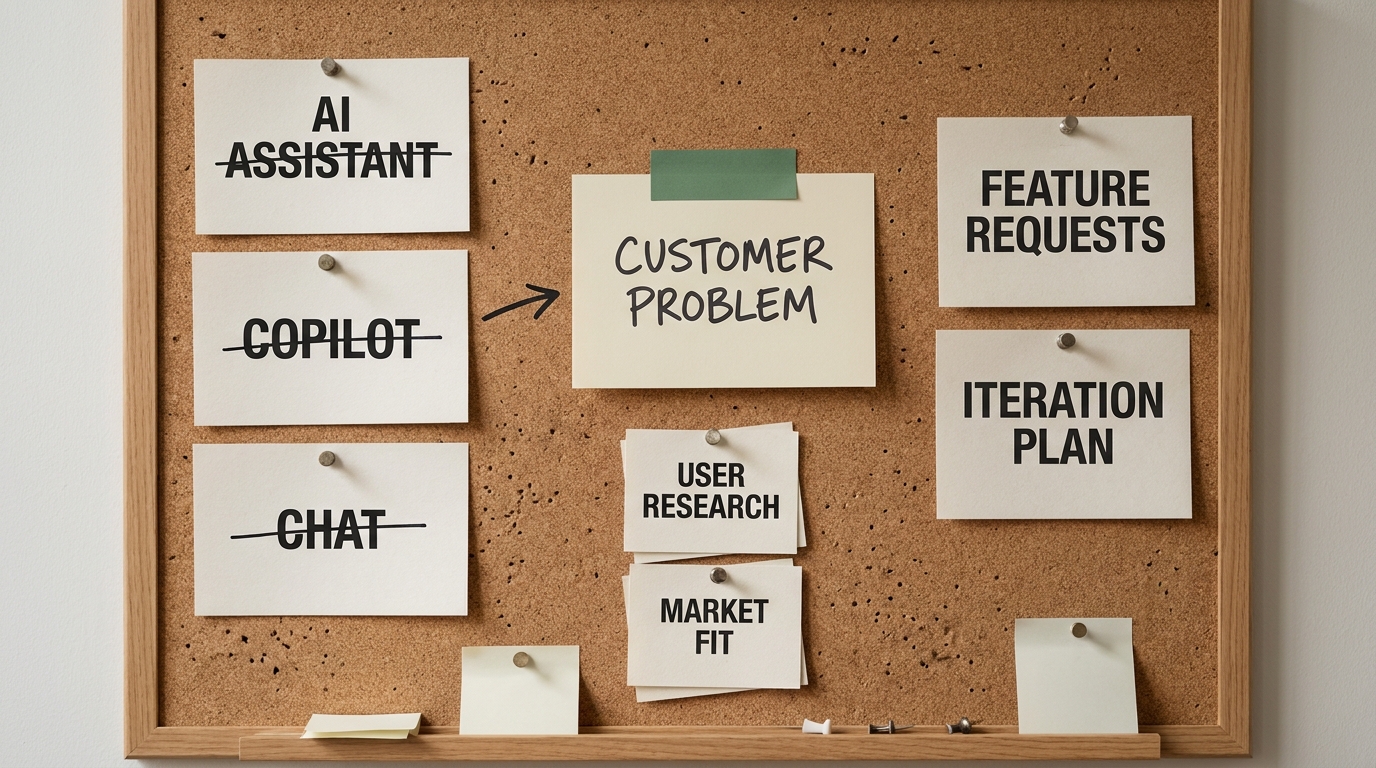

"AI is getting better at writing code" is the sentence that hides the real change. Better autocomplete is a faster keyboard. What is arriving in engineering orgs is a different kind of thing: software that does not suggest the next line but plans a unit of work, executes it, runs the result, and fixes its own mistakes before a human ever looks. The keyboard stops being the thing that produces software. A workflow does.
That difference is not academic, and it lands on a technology leader's desk. When the unit of work was a keystroke, your decision was which editor or model to buy. When the unit of work becomes a delegated workflow, the decision changes shape: who is allowed to own that workflow, how you confirm it did the right thing, and what has to be true before it touches anything that matters. This piece defines agentic engineering as that ownership transfer. It also hands you a way to govern the transfer, so you can decide what agents own, how you check their work, and which controls have to exist before you grant autonomy.
What agentic engineering actually is
Agentic engineering is the practice of delegating whole units of software work to AI agents that plan, execute, and self-correct, while engineers own the goals, the guardrails, and the review. Short version: the shift is from owning keystrokes to owning outcomes.
The word doing the work here is agent. An agent is software that can both decide and act. It does not just propose a code change for you to accept. It reads a ticket, searches the codebase, writes the change, runs the tests, reads the failures, and tries again, looping until it meets a goal or gives up. Google Cloud (2026) frames agentic coding around this autonomy: the system pursues a goal across multiple steps rather than answering a single prompt. That is the line between an agent and a suggestion box. A suggestion box waits for your next keystroke. An agent runs a loop.
So define the thing once and hold it steady for the rest of this article. Agentic engineering is not a tool you install. It is an operating model where some software work goes to agents and some controls stay with humans, and the whole leadership job is drawing that boundary well.
Autocomplete-with-vibes is the opposite of agentic engineering
Three things get jammed together in casual conversation, and the conflation is how teams ship expensive mistakes. They sit on a single line, and the line is worth drawing with care.
At one end is autocomplete. The human owns every keystroke. The AI offers the next token, the next line, the next function, and a person accepts or rejects each one. Productivity climbs, but ownership never moves. The engineer still authors every character that ships.
In the middle is vibe coding. The human prompts in natural language, watches code appear, and accepts it without really reading it, steering by feel instead of by review. Andrej Karpathy popularized the term in 2025 for throwaway, exploratory building where you "give in to the vibes" and barely look at the diff. Vibe coding is still keystroke-bound in spirit. The human is still driving turn by turn. What it has dropped is the discipline. It is fast and it is reckless.
At the other end is agentic engineering. The agent owns the workflow. The human owns the goal, the acceptance criteria, and the review. The discipline that vibe coding threw away comes back, but in a new place. Instead of reviewing every keystroke, you engineer the guardrails and the checks that the agent's output has to pass.
Here is the conflation that hurts teams. People treat vibe coding and agentic engineering as synonyms because both involve "the AI writes the code." On the axis that matters, which is discipline, they are closer to opposites. Simon Willison (2025), who has written extensively on defining this category, draws the same distinction: agentic engineering is the disciplined practice, not the casual one. Good looks like an agent operating inside tests, evals, and explicit permissions. Reckless looks like an agent, or a person, shipping unreviewed output because the demo looked fine. The technology can be identical. The operating model is what makes one production-grade and the other a liability.
The real shift: from keystrokes to workflow ownership
Strip away the tooling debate and a single move explains the rest. The unit of progress changes from "lines I typed" to "work I delegated and verified." Once you see that move, the rest of the leadership agenda falls out of it.
Back when a senior engineer's output was measured in keystrokes, every control wrapped around the keystroke. Code review looked at lines. Pair programming watched lines get typed. Standards documents described how lines should be written. All of it assumed a human hand on the keyboard, producing each character.
Move the unit of work up to a delegated workflow and every one of those controls now points at the wrong target. Reviewing each line an agent wrote does not scale. The agent produces more diff in an hour than a team can read in a day. And line-by-line review misses the real risk, which is not a bad line but a wrong goal pursued competently. The controls have to move up a level too, from "was this line written well" to "was the right work delegated, did it meet its acceptance criteria, and can I see what it did."
This is why agentic engineering is a governance problem before it is a tooling problem. The CIO (2026) coverage of agents reshaping the software lifecycle lands in the same place: the hard part is not getting agents to act, it is restructuring the organization's controls around the fact that they do. The leadership question stops being "which IDE plugin do we standardize on." It becomes "what decision rights, eval loops, and production controls do we put around a thing that now owns work." The rest of this article is that toolkit.
Decision rights: Autonomous, Approve-before, Review-after
The first and most important artifact is a decision-rights model. Most teams skip it and grant autonomy by accident , by whatever the tool happens to default to. That is the same mistake as giving every new hire production database access on day one because nobody set up roles.
Three tiers cover the field. Assign every task type an agent might do to exactly one of them.
Autonomous. The agent owns the workflow end to end and humans audit afterward, on a sample. This fits work that is low blast-radius, easy for automated checks to verify, and cheap to reverse. Dependency version bumps with a green test suite. Generating unit tests for existing code. Routine documentation updates. Mechanical refactors that leave behavior unchanged and are protected by tests.
Approve-before. The agent proposes a complete change, but a human approves before anything executes or merges. This fits work that is irreversible, high blast-radius, or hard to verify automatically. Schema migrations. Production configuration changes. Anything touching auth, billing, or data deletion. Infrastructure changes that could take down an environment. The agent does the work. A human owns the go decision.
Review-after. The agent acts, and a human reviews the result on a defined cadence, before it reaches users. This is the broad middle: feature branches behind flags, refactors that pass tests but change structure, bug fixes with reproduction tests. The work lands in a reviewable state, gated by a flag or a staging environment, and a human signs off before users see it.
The table below is the version worth pasting into a team wiki.
| Task type | Tier | Required control |
|---|---|---|
| Dependency bumps, test generation, doc updates | Autonomous | Green test suite, post-hoc audit on a sample |
| Feature work behind a flag, structural refactors | Review-after | Flag or staging gate, human review before exposure |
| Schema migrations, prod config, auth and billing | Approve-before | Human approval before execution, change record |
Two rules keep the model honest. First, a task type earns its tier. Autonomy is granted per category once the controls below exist, never as a blanket default. Second, the tiers run both ways. If an autonomous category starts throwing surprises in the post-hoc audit, it drops back to review-after until you understand why.
Eval loops: how you know the agent did the right thing
Once an agent owns a workflow, "did it do this correctly" can no longer be answered by a human reading the output. There is too much of it, and the human is no longer in the loop keystroke by keystroke. The answer has to be machine-checkable. That is what an eval loop is: the set of automated gates that decide whether the agent's work is acceptable, run by the agent on itself and again by your pipeline.
The new definition of done is "passes the evals," and the evals become a first-class artifact you design on purpose. For a coding task that means the existing test suite, plus new tests that encode the acceptance criteria for this specific change, plus checks the agent cannot game its way past: type checks, lint, security scans, and where it matters, a behavioral or output eval that scores whether the result meets the goal rather than merely compiles .
The bottleneck moves, and leaders should plan for where it lands. When humans wrote the code, prompt quality and developer skill were the constraint. When agents write the code, eval coverage is the constraint. An agent will happily produce a confident, well-structured, completely wrong change, and the only thing between that change and your users is whether you had a check that would catch it. The teams getting value from agents are usually the ones that already had strong automated testing, because the agent inherits the safety net the test suite provides. Teams with thin coverage find that agents amplify their existing quality gaps instead of fixing them.
A practical loop around an agent task runs like this. The agent receives a goal and the acceptance criteria as explicit, checkable statements. It writes the change and runs the full check set. On failure it reads the output and revises, looping until the checks pass or a retry budget runs out. Only a passing result gets surfaced for the tier's required control, whether that is an audit, a review, or an approval. The human's job moved from writing the code to designing the checks that define "right."
Observability: you cannot govern what you cannot see
A control you cannot observe is a control you do not have. The moment an agent acts on its own, you need a record of what it did, good enough to answer three questions after the fact: what action did it take, why did it take it, and can I reproduce the reasoning.

In practice that means treating agent actions the way you treat any other production actor. Every action attributable, so you know which agent, running which task, under whose delegation, made this change. Every action traceable, so the steps the agent took, the tools it called, and the intermediate decisions sit in a log you can replay, not lost inside a chat window. Every action reviewable, because the diff is the reviewable surface for code, but the trace is the reviewable surface for behavior, and a CTO should require both.
Why is this non-negotiable? Accountability, which the next section picks up, but the mechanism underneath it is observability. When something goes wrong, and it will, the gap between a five-minute root cause and a two-day investigation is whether the agent's actions were logged with enough fidelity to reconstruct what happened. AgentOps practices, the operational discipline AWS (2026) describes for running agents at scale, treat this telemetry as a requirement rather than a nice-to-have, for the reason application observability became a requirement: you cannot operate at scale what you cannot see.
The bar to set is concrete. Before an agent runs autonomously against anything that matters, require that its actions are logged, attributable to a delegating human, and replayable in enough detail to review the decision, not just the outcome.
Production controls: guardrails are earned before autonomy
Decision rights say who is allowed to own what. Eval loops say how you check the work. Production controls are the physical limits that make the whole thing safe to run, the blast-radius reduction that means a wrong call by an agent is survivable.
These controls are not exotic. They are the ones you already use for risky human changes, applied on the assumption that the actor is fast and tireless. Permissions and sandboxing: an agent gets the narrowest access its task requires and nothing more, with scoped credentials, a sandboxed environment, and no standing production access by default. Blast-radius limits: rate limits on actions, caps on how much an agent can change in one run, environment boundaries that keep an agent in staging until a control promotes its output. Rollback: every agent-driven change reversible by design, through feature flags, versioned deploys, and database migrations with a tested down path. Change management: agent changes flow through the same review, record, and release process as human changes, not a side channel that skips it.
The rule that ties production controls to decision rights is simple, and worth stating plainly. Autonomy is earned per task type once the controls exist, never granted by default. A task type reaches the autonomous tier only after it has the evals to verify it, the observability to audit it, and the production controls to contain it. Until then it lives in review-after or approve-before. The default for anything new is not autonomy. It is the most restrictive tier that still gets the work done, and categories graduate toward autonomy as the controls around them prove out.
What changes by role, and how to get there
The ownership shift does not eliminate roles. It changes what each one is accountable for. Naming the new accountabilities is half the adoption work, because a role nobody re-scoped is a control nobody owns.
The CTO or VP of Engineering owns the decision-rights model itself: which task types sit in which tier, and the standard for what controls a tier requires. This is the new strategic artifact, and it is theirs.
Engineering managers own eval coverage and review cadence. If eval coverage is the real bottleneck, then the manager who owns a team's test and eval suite owns that team's ability to use agents safely. Review-after only works if someone owns the "after."
Senior individual contributors shift from typing to supervising and designing guardrails. A senior engineer's leverage used to be writing the hard code fast. Now it is designing the evals, setting the task boundaries, and reviewing agent output with the judgment that tells a competent-looking wrong answer from a right one. Prisma (2026), writing about how its engineering org actually adopted agentic workflows, describes this move directly: senior engineers spending more time specifying and verifying, and less time typing.
Junior individual contributors are the hard case, and pretending otherwise helps nobody. The grunt work juniors learned on, the small fixes, the boilerplate, the first pass at a feature, is the exact work agents now do well. If that work simply vanishes, the path that grows a junior into a senior vanishes with it. This is the nurturing gap, and it is a leadership decision, not an accident. Teams that take it seriously route some agent-suitable work to juniors as a teaching exercise, have juniors review and correct agent output to build judgment, and treat eval design as a skill juniors learn early rather than a senior-only task.
The adoption path follows from the model, and it does not require a big-bang rewrite. Start with review-after on low-risk task types, the work where a mistake is cheap and visible. Add eval loops around that work so "done" becomes machine-checkable. Build the observability to audit what the agents did. As a category proves out, expand to approve-before for the higher-stakes work, with a human on the go decision. Finally, graduate the safest, best-covered task types to autonomous, with post-hoc audits. Each step adds a control before it adds autonomy, which is the whole point.
Key takeaways
- Agentic engineering is an ownership transfer, from human-owned keystrokes to agent-owned workflows, not a faster way to type. Everything a leader does follows from governing that transfer.
- Vibe coding and agentic engineering are opposites on the discipline axis, not synonyms. One drops review. The other moves review from keystrokes to guardrails and checks.
- The reusable artifact is a decision-rights model, Autonomous, Approve-before, Review-after, with every task type assigned to exactly one tier.
- Eval coverage, not prompt quality, becomes the bottleneck once agents own work. The new definition of done is "passes the evals."
- Autonomy is earned per task type once the evals, observability, and production controls exist, never granted by default.
Adopting this operating model is mostly an organizational change, and the fastest way through it is to work alongside a team that already runs it. If you want an embedded team that already operates this decision-rights model, with the eval loops, observability, and controls in place, talk to us about a Fractional Agentic Team . If you would rather start smaller, a free AI Readiness Snapshot is a 30-minute first look at where your current controls stand and which task types you could safely hand to agents first.