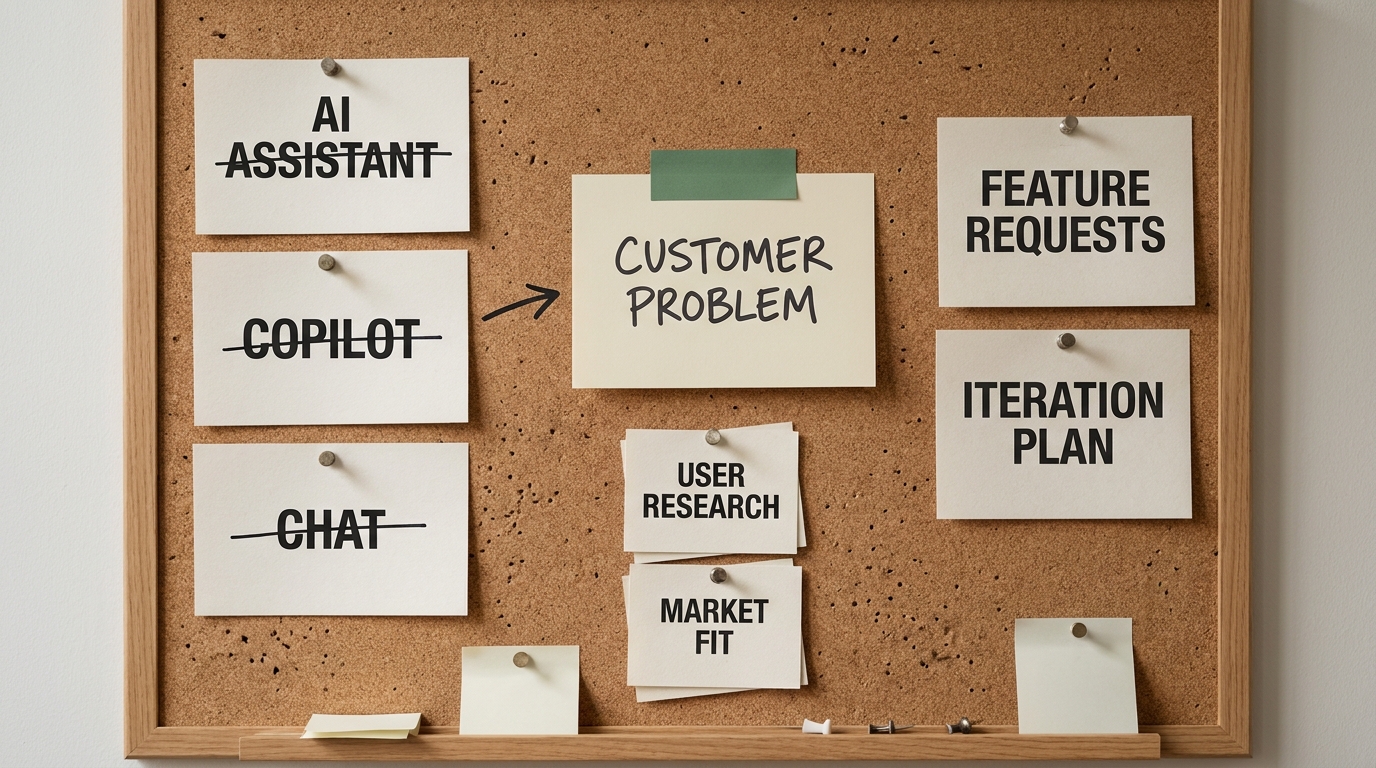

Search "AI implementation consulting" and every result blurs into the same promise: a roadmap, a framework, a clear path to ROI. What almost none of them explain is the thing a buyer most needs to know before signing anything - what the consultant actually does once the work starts, and why so many well-funded AI projects still end with a pilot that technically works and a business that runs exactly as it did before.
That gap is the whole subject here. AI implementation is not primarily a technology problem. It is an operational change with a technology component, and managing that change is what implementation consulting exists to do. If your worry is that you will spend real money, watch a proof of concept succeed, and then watch nothing change, you are worrying about exactly the right thing. Everything below is about avoiding that outcome, whether you hire help or not.
What AI implementation consulting actually is
AI implementation consulting takes an AI idea and turns it into a working system that people actually use to do their jobs. Not a demo. Not a slide. Not a sandbox model that impresses a steering committee. A consultant in this role owns the messy middle : picking the right use case, getting the data and tooling ready, building or integrating the solution, and then doing the unglamorous work of changing how a team operates so the tool sticks.
Leaders buy it when they have decided AI matters but do not have the internal capacity, experience, or bandwidth to get from intent to production. The one outcome it should deliver is a system that is live, adopted, and producing measurable value - not a report recommending that you build one.
AI strategy vs. AI adoption vs. AI implementation
These three terms get used interchangeably, and that confusion is expensive, so it is worth defining each once.
- AI strategy answers "where should we use AI, and why?" It is the decision layer: priorities, business cases, and the bets worth making.
- AI implementation answers "how do we build this specific thing and put it into real workflows?" It is the delivery layer, and it is where most initiatives quietly break.
- AI adoption answers "are people actually using it, and is it changing how work gets done?" It is the behavior-change layer that decides whether implementation produced value or just produced software.
A good strategy with no implementation is a document. A good implementation with no adoption is expensive shelfware. Consulting that only touches strategy leaves you with a plan and no delivery. The engagements that create value carry an idea all the way through implementation and into adoption .
Why most AI implementations fail (and it is rarely the technology)
Here is the uncomfortable pattern behind stalled AI projects: the model usually works fine. Industry analyses and surveys have repeatedly estimated that a large majority of corporate AI initiatives never reach production or fail to show measurable ROI. Treat that as a widely-cited range rather than a hard number, but the direction holds across sources. Most of the failure has nothing to do with model quality.
The real root causes are operational, and they are predictable:
- Workflows are never redesigned. The tool gets bolted onto a process built for humans doing it the old way, so it adds a step instead of removing one.
- Data is not ready. The information the model needs is scattered, inconsistent, or locked in systems nobody wants to touch, and that surfaces only after the build starts.
- There is no change management. People are handed a new tool with no enablement, no incentive, and no reason to trust it, so they route around it.
- No single person owns the outcome. The pilot has a sponsor for the launch, but nobody is accountable for whether it is still delivering value six months later.
Put the root cause next to what good looks like and the fix stops being abstract:
- Model-first thinking becomes problem-first thinking - the use case is chosen because it removes a real bottleneck, not because it demos well.
- A bolted-on tool becomes a redesigned workflow - the process is rebuilt around what the AI now handles.
- "Ship it and hope" becomes enablement and measurement - people are trained, and value is tracked against a baseline set before launch.
- A launch sponsor becomes a standing owner - one accountable person carries the outcome past go-live.
Nothing in that second column is about a better model. That is the point. The failure mode named at the start, the pilot that worked while nothing changed, is almost always one of these four gaps rather than a technical shortfall .
What an AI implementation consultant actually does
This is the section most competitor articles skip, which is exactly why it is worth being concrete. Across a typical engagement, the work moves through distinct phases, each with a real deliverable rather than a vibe.
- Discovery and use-case selection. The consultant maps your workflows, finds where AI removes genuine friction, and ranks candidates by value and feasibility. Deliverable: a short, prioritized list of use cases with expected impact, not a wish list.
- Data and tooling assessment. They check whether the data behind the top use case is actually usable and what integration surface the build will touch. Deliverable: a readiness assessment that surfaces the ugly surprises before you are committed to them.
- Build and integration. They build or configure the solution and wire it into the systems your team already uses. Deliverable: a working system inside your real environment, not an isolated prototype.
- Adoption and enablement. They train the people who will use it, adjust the workflow around it, and remove the friction that makes people abandon new tools. Deliverable: a team that uses the thing without being reminded to.
- Measurement. They define the baseline before launch and track outcomes against it. Deliverable: evidence of value - hours saved, errors reduced, throughput gained - measured, not asserted.
Week to week, a good consultant spends far more time on workflow, data, and people than on the model itself. So here is the sharpest filter you can apply to any pitch. If a prospective partner talks only about models and never mentions adoption or measurement, they are selling you the easy 20 percent and leaving you the hard 80.
The AI implementation roadmap, phase by phase
Most roadmaps you will read are generic numbered lists, and generic numbered lists are useless. A roadmap earns its keep only when each phase is defined by the decision it de-risks, not by its step number. Read this as the consultant's operating system.

- Assess. Decide what is worth building and whether the data can support it. The decision this phase de-risks: are we about to invest in something that cannot actually work here? Skip it and you discover a data problem three months and a large budget too late.
- Pilot. Build one narrow, measurable use case and prove value against a baseline. The decision this de-risks: does this deliver real value before we scale the spend? A pilot exists to earn the right to phase three, not to look good in a demo.
- Integrate. Fold the proven solution into real workflows so it becomes how work is done, not an optional extra. The decision this de-risks: will people actually use this once the novelty fades? This is where redesign and enablement live, and where most projects that skipped it stall.
- Scale and operate. Extend to more teams or use cases and set up ownership, monitoring, and maintenance. The decision this de-risks: will this still be delivering value a year from now, or quietly decay?
The sequence is not decoration. Each phase protects the investment of the next, which is why scaling before the pilot proves value is the single most common and most expensive mistake in the whole cycle.
If you are at the start of this and unsure whether your data and use cases can support any of it, a low-commitment AI Readiness Snapshot is a faster, cheaper way to find out than launching a build and discovering the answer the hard way. When you are ready to scope a specific use case in depth, a Discovery Sprint turns a vague ambition into a costed, sequenced plan.
Do you actually need a consultant? In-house vs. partner vs. platform
Bringing in outside help is not automatically the right move, and a good consultant will tell you when it isn't . Here is an honest read on when each option fits.
In-house works when you already have data engineers and ML-literate people, the use case is well understood, and you have the bandwidth to run a delivery project without starving your other priorities. If that describes you, a consultant may only add cost.
A consultant is worth it when you have a real talent or experience gap, when speed matters and you cannot wait to hire, or when you have already tried internally and stalled. The value is not just building. It is having someone who has seen the failure modes before and steers around them. For teams that need capability embedded rather than a one-time project, a fractional AI team can sit inside your operation and build alongside your people rather than handing over a deliverable and leaving.
A platform alone falls short when the vendor sells you a capable tool but none of the workflow redesign, data preparation, or change management that turns the tool into an outcome. Platforms are enablers, not implementations. Buying one and expecting adoption to follow is a version of the same mistake that stalls internal projects.
The honest test: if the hard part of your situation is the operational change , not the code, outside help earns its cost. If the hard part is just capacity on a well-understood build, you may not need it.
How to choose an AI implementation partner
This is where the market gives buyers almost no help, so bring your own lens. Judge a partner on the few things that actually predict success, and treat everything else as noise.
Evaluation criteria worth weighting heavily:
- Business-outcome focus. They talk first about the problem and the measurable result, not about models and tooling.
- Workflow and change-management capability. They can describe how they drive adoption, not just how they build.
- Data engineering depth. They take data readiness seriously and raise it early, because that is where builds actually break.
- References and relevant experience. They can point to comparable work and are specific about what they delivered.
- Handover and enablement. They plan for you to own and run the system, rather than making you dependent on them.
Questions worth asking directly:
- How do you decide which use case to start with, and why?
- What happens if the data is not ready when we start?
- How do you measure whether this delivered value?
- What does adoption look like, and who is responsible for it?
- When the engagement ends, what do we own and what do we still depend on you for?
Red flags to walk away from:
- A partner who only demos models and never mentions adoption, workflow, or measurement.
- Promises of a fixed ROI number before they have seen your data or your processes.
- No plan for enablement or handover, which usually signals a dependency-by-design business model.
- A pitch that treats implementation as an IT project rather than an operational change.
If a firm cannot answer the measurement and adoption questions crisply, that is your answer.
What AI implementation consulting costs (and what drives the price)
Real numbers here are ranges, not fixed prices, because scope varies enormously. Anyone quoting you a precise figure before understanding your situation is guessing or anchoring. What is genuinely useful is knowing what drives the cost, so you can read a proposal critically instead of taking it on faith.
The main cost drivers:
- Scope. A single narrow use case is a fraction of the cost of an enterprise-wide program. Start narrow and the number stays sane.
- Data readiness. Clean, accessible data keeps costs down. Scattered or messy data can make data preparation the largest line item, sometimes larger than the build itself.
- Integration surface. Wiring into one system is cheap. Wiring into many legacy systems, each with its own quirks, is where hours accumulate.
- Change-management load. A tool for a small, willing team is straightforward. Rolling out across a large organization with real behavior change is a serious effort and priced accordingly.
The practical takeaway is a good one for buyers: you control more of the price than the vendor does, mostly by scoping tightly and by investing in data readiness before the build. A smaller, well-scoped first engagement that proves value is almost always a better buy than a sprawling program bought on faith.
What good looks like: two short examples
These are illustrative scenarios, not real clients, meant to show the shape of a well-run implementation. In both, watch where the win actually comes from.
A mid-sized professional-services firm automating intake. The bottleneck was not answering client questions. It was the hours spent sorting, tagging, and routing inbound requests before anyone could act. The implementation did not start with a chatbot. It started by redesigning the intake workflow around an AI classifier that triaged and routed requests automatically. The before-and-after was not "we have AI now." It was that a task consuming a chunk of every day for several staff became near-instant, and the people freed up moved to higher-value work. The value showed up in the redesigned workflow, not the model.
An operations team removing a back-office bottleneck. A repetitive reconciliation task ate hours each week and was prone to human error under time pressure. Rather than scaling a tool across the whole finance function on day one, the team piloted narrowly on that single task, measured error rate and time against a baseline, proved the gain, and only then integrated it into the standing process with a clear owner. That discipline - narrow pilot, measured, then integrated - was the difference between a real improvement and another stalled experiment.
In both cases the win came from operational change plus measurement, not from a more impressive model.
Common pitfalls to avoid
Even well-intentioned projects fall into the same traps, in roughly the same order. Watch for these:
- Scaling before the pilot proves value. The most expensive mistake in the cycle. Prove it small, then grow.
- Automating the wrong process first. Picking the flashy use case over the one that removes a genuine bottleneck wastes the first, most-scrutinized win.
- Treating it as an IT project. Implementation is operational change. Run it as pure IT and adoption never happens.
- No single owner. Without one accountable person past go-live, value quietly decays and no one notices until it is gone.
- Ignoring enablement. People do not adopt tools they were not trained to trust. Skipping enablement is skipping the entire point.
Every one of these is a management failure, not a technology failure, which is exactly why they are avoidable.
Key takeaways
- AI implementation is an operational change with a technology component, not a technology project. The model is rarely the hard part.
- The failure mode to fear is "the pilot worked and nothing changed." It comes from unredesigned workflows, unready data, missing change management, and no clear owner.
- A consultant's real job is delivery and adoption - use-case selection, data readiness, build, enablement, and measurement - not producing a strategy document.
- Follow the roadmap in order: assess, pilot, integrate, scale. Scaling before the pilot proves value is the classic, costly error.
- Buy on outcomes and enablement, not demos. If a partner talks only about models and never about adoption or measurement, keep looking.
- You control most of the cost by scoping tightly and getting data ready before the build.
The reframe worth keeping is one sentence: AI implementation succeeds or fails on operational change, not model choice. The right next move is not a giant contract. It is a small, honest check of whether you are ready. A free AI Readiness Snapshot is exactly that kind of low-commitment starting point, and it beats discovering your readiness gaps mid-build.