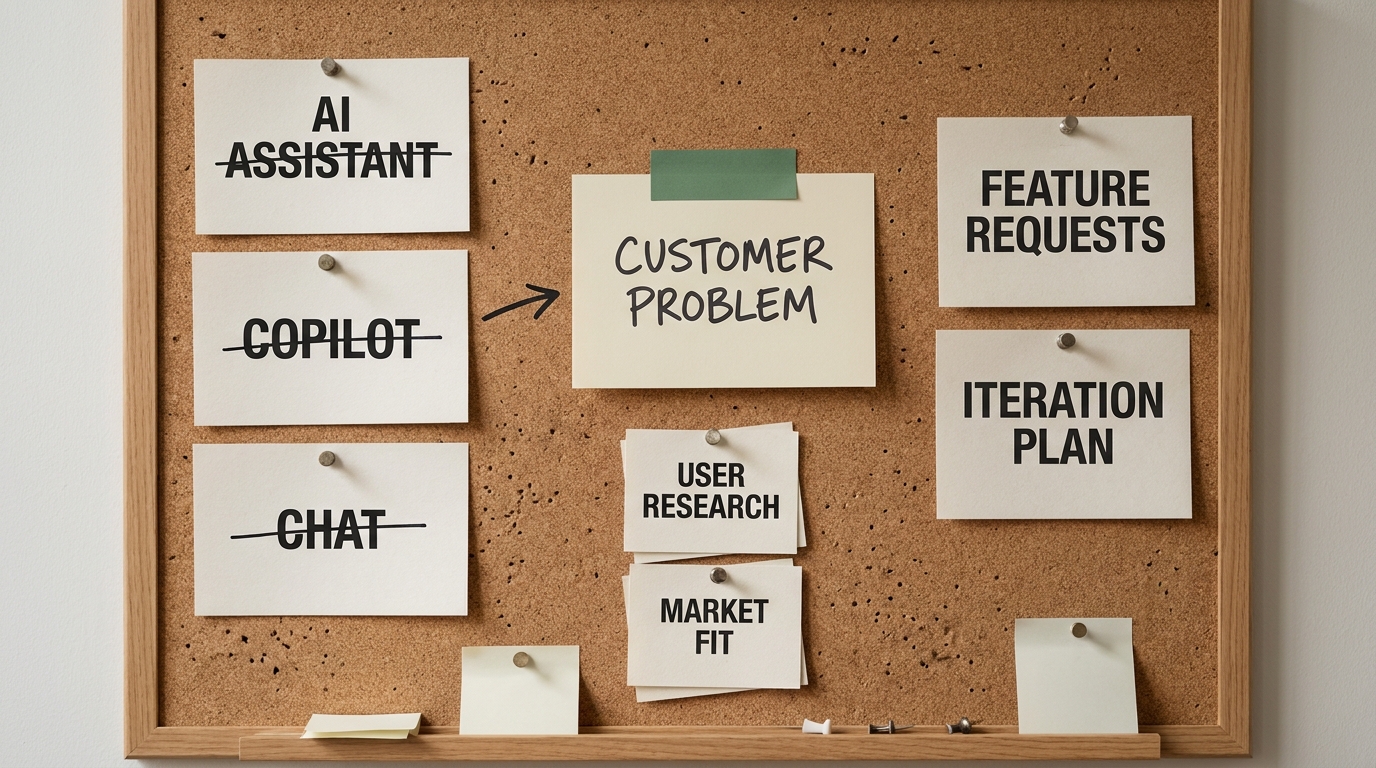

In 2026, one of the largest consulting firms in the world told its own staff to stop using generative AI for tasks that did not need it. Not for safety reasons. For cost. Token spend had climbed fast enough that a company selling AI transformation to everyone else had to put guardrails on its own people. That one decision tells you more about the real state of generative AI than any capability slide ever will. The technology works. Getting it to pay back, safely, at a cost you can actually predict, is the part almost nobody has cracked. That gap, between a pilot that impresses the room and a production system that moves a real number without quietly bankrupting you, is where a generative AI consulting engagement earns its keep.
Most teams reading this are not starting cold. You have run a chatbot demo, a document summarizer, maybe an internal copilot. Some of it went over well in a meeting. None of it is reliably in production, watching its own costs, or measured against a business metric anyone would defend to a board. The model is rarely the problem. The problem is the distance between a proof of concept and a system that runs every day under real load, real data, and a real budget. This page walks through what generative AI consulting services actually deliver, how a real engagement gets scoped, what it costs and how that cost stays in check, and who this work suits, and who it does not.
What generative AI consulting actually is
Generative AI consulting is the work of moving an organization from scattered experiments to production systems built on large language models and related generative techniques, then keeping those systems running responsibly. It comes down to four jobs: deciding which use cases are worth building, designing and building them, deploying them under real governance, and operating them so they stay accurate and cost-controlled after launch.
That last job is where the term gets slippery. A large share of firms selling generative AI consulting stop at strategy and a proof of concept. They run a discovery workshop, name a dozen opportunities, stand up a demo, and move on. Far fewer will credibly own the operate phase, meaning the monitoring, the cost control, the evaluation, the iteration that keeps a system useful six months later . So when you size up providers, the sharpest question is not "can you build a RAG assistant." Almost everyone can. It is "who runs it after it ships, and how do you keep it from quietly getting slower, more expensive, or wrong." The answer to that is the whole game.
Generative AI consulting is also a different animal from general AI or data-science consulting, and the difference is not cosmetic. Traditional machine-learning work usually builds a bespoke model from your data for a narrow prediction task. Generative AI work usually starts from a foundation model somebody else trained, then focuses on grounding it in your data, constraining how it behaves, and wiring it into a workflow. The skills overlap, but the delivery and the risk profile do not. Hallucination, prompt injection, data leakage, runaway token cost, these are generative-specific failure modes, and an engagement worth paying for has an explicit answer for each one before it writes a line of production code.
What you get from generative AI consulting services
A real engagement is a set of concrete deliverables, not a menu of capabilities. Here is what a complete generative AI consulting program actually produces:
- Use-case discovery and prioritization. A short, honest ranking of the generative AI bets in front of you, scored on business value, feasibility, and data readiness. You get a shortlist of what to build first and a plain list of what to skip, so you stop spreading effort across a dozen half-pilots that each die at 60 percent.
- Strategy and roadmap tied to metrics. A sequenced plan where every initiative names the number it is supposed to move, whether that is support resolution time, document turnaround, or engineering throughput, instead of a generic "improve efficiency" that nobody can audit later.
- RAG, agents, and LLM application development. The build itself: retrieval-augmented generation over your knowledge, agentic workflows that take multi-step actions, and the application layer that puts them in front of real users.
- Model selection, fine-tuning, and evaluation. Picking the right model tier for each job rather than reaching for the most expensive one out of habit, fine-tuning or prompt-engineering where it earns its cost, and standing up an evaluation harness so quality gets measured instead of assumed.
- Secure, governed deployment. Data-privacy controls, access boundaries, guardrails against prompt injection and unsafe output, and an audit trail, delivered as concrete artifacts a reviewer can hold: a data-flow map, a model-evaluation log, and access decision-rights that map to the obligations you carry, whether that is the EU AI Act, NIST AI RMF, or your own internal policy. This is the exact line between a demo and something legal and security will actually sign off on.
- Cost and performance optimization. Right-sized models, caching, batching, and evaluation gates that hold token and compute spend inside a budget instead of surprising you at month-end.
- Ongoing operation and iteration. Monitoring for drift and quality regressions, a feedback loop from real usage, and a steady cadence for improving the system after launch.
Best for: teams that are past the pilot stage , have real data to ground a system in, and need to reach production with governance and cost control they can defend to a board.
Not for: organizations shopping for a one-off demo to show at a conference, or teams with no data foundation and no appetite to build one. Generative AI consulting is a delivery relationship, not a magic-show booking. If all you want is a flashy proof of concept and nothing behind it, a cheaper vendor will happily oblige, and you will be right back where you started a quarter later, one demo richer and no closer to production.
How a generative AI engagement works
A well-run engagement moves through four phases. The shape stays deliberately simple so that everyone, your team, the consulting team, and the executives paying for it, can see exactly where value is being created and where it is not.

- Discover. Two to three weeks of use-case ranking, data-readiness assessment, and cost modeling. You come out with a prioritized shortlist, a realistic read on what your data can actually support, and a rough budget envelope for the first build. Nothing is committed to code yet, which is the whole point. The cheapest moment to kill a bad idea is before it has an engineer attached to it.
- Design. The chosen use case gets a technical design: which model, what retrieval architecture, what guardrails, what the evaluation criteria are, and how success gets measured in production. Security and privacy requirements are baked in here, not bolted on later when they are ten times harder to add.
- Build and ship. The system gets built, evaluated against the criteria set in design, and deployed to real users under monitoring. Shipping to production is the milestone, not a demo. A demo runs once in a controlled room with a friendly audience. Production runs on a Tuesday afternoon when everything is on fire and the model still has to behave.
- Operate. The phase most vendors skip, and the one that decides whether the investment holds. Monitoring catches quality drift and cost creep. Evaluation reruns catch regressions when a model version changes underneath you. In practice that is a small eval set run automatically on every model or prompt change, owned by the same team that ships, so it rides the existing release cadence instead of becoming a separate gate nobody has time for. A feedback loop turns real usage into steady improvement. This is ongoing work, and pretending otherwise is exactly how "successful" AI projects quietly rot.
The operate phase is the honest dividing line between advice and delivery. Plenty of firms will get you to a shipped system and then hand you the keys. Fewer stay to run it, and running it is where the real ROI, and the real risk, actually live.
If your team has already done its own discovery and knows which use case matters, a focused Discovery Sprint compresses the design phase into a fixed-scope engagement that ends with a build-ready plan and a defensible cost model.
Generative AI use cases we build
The use cases that reach production and stay there tend to share one trait. They are grounded in a specific workflow with a measurable outcome, not a general "AI assistant" with no owner and no number attached. These are the ones that most reliably pay back.
- Enterprise knowledge assistants (RAG). A retrieval-augmented assistant that answers questions from your own documents, policies, and systems, with citations back to the source so answers can be trusted and checked. What you get is faster access to institutional knowledge and less time lost digging through wikis and tickets.
- Document and contract processing. Extraction, summarization, and classification over contracts, invoices, claims, or reports. What you get is turnaround cut from days to minutes on work that used to mean a person reading every page.
- Customer-support copilots. A model that drafts replies, surfaces relevant knowledge, and clears routine tickets while routing the hard ones to humans. What you get is lower resolution time and support staff spending their attention where judgment actually matters.
- Code and engineering acceleration. Generative tools embedded in the development workflow for code generation, review, and documentation, scoped and governed so they speed delivery without piling up security or quality debt.
- Content and marketing generation. Drafting and variation at scale for campaigns, product copy, and internal communications, with brand and accuracy guardrails so volume does not cost you control.
- Internal agentic workflows. Multi-step agents that take actions across systems, pulling data, updating records, triggering processes, for well-bounded internal tasks where the steps are known and the blast radius is contained.
Each of these ties to an outcome, not a feature. The technology underneath is interchangeable. The workflow it improves is what you are actually buying.
Industries we serve
Generative AI consulting is not industry-agnostic in practice, because the data, the regulation, and the highest-value use cases shift sharply by sector. Here is a short view of where the wins tend to concentrate:
- Financial services. Document-heavy processes, research summarization, and support automation, delivered under strict data-governance and audit requirements.
- Healthcare. Clinical and administrative document handling, knowledge retrieval, and patient-communication support, with privacy and accuracy as non-negotiable constraints.
- Retail and e-commerce. Product content generation, customer-support copilots, and merchandising assistance where speed and scale drive the return.
- Manufacturing. Technical-documentation retrieval, maintenance knowledge assistants, and process support that put decades of institutional knowledge within reach of the floor.
- Professional services. Proposal and report drafting, research acceleration, and knowledge management for firms whose entire product is expertise.
- Real estate and PropTech. Listing and document processing, market-research summarization, and property-data assistants that cut manual research time.
The vertical sets the constraints and the priority order. The delivery discipline stays the same.
The technologies and models we work with
Good generative AI delivery is deliberately vendor-neutral. The right stack depends on your data, your security posture, and your budget, not on whichever platform a consultant happens to have a partnership with. A capable engagement works fluently across these layers:

- Foundation models. The major hosted model families and strong open-weight alternatives, chosen per use case. Frontier models for hard reasoning, smaller and cheaper models for high-volume routine work. Model choice is a cost decision as much as a quality one.
- Retrieval and vector infrastructure. RAG pipelines and vector databases that ground models in your data, which is what separates a reliable assistant from a confident guesser.
- Agent and orchestration frameworks. The tooling that lets models take multi-step actions and coordinate across systems, applied where an agentic pattern genuinely fits and left alone where a simpler call would do.
- Evaluation and observability. Harnesses that measure output quality, and monitoring that watches cost, latency, and drift in production. Skip this layer and you are flying blind, which is how projects get expensive and wrong at the same time.
- Cloud AI platforms. The major cloud providers' AI services, integrated into your existing environment and security controls rather than standing up a parallel shadow stack.
The point is not logo soup. It is matching each layer to the job so the system comes out accurate, secure, and affordable, and so you are never locked into one vendor's roadmap.
What generative AI consulting costs - and how we control it
This is the section most competitor pages dodge, which is exactly why it belongs here. Generative AI has no fixed price, and any firm quoting one before it understands your use case is guessing. What can be named honestly are the cost drivers and how a disciplined engagement keeps each of them in check.

Three things drive the bill. The first is token and compute spend. Every model call costs money, and a system that fires a frontier model at work a small model could handle burns budget for no reason. That is the exact trap that pushed a major consultancy to ration its own staff's AI usage in 2026. The second is scope. A single well-bounded use case costs a fraction of an open-ended "transform everything" program, and the teams that keep spend under control start narrow on purpose. The third is data readiness. If your data is scattered and ungoverned, a real share of the work, and the cost, goes into making it usable before any model touches it.
A disciplined engagement handles all three on purpose:
- Right-sized models. Match the model tier to the task instead of defaulting to the most powerful option. High-volume routine calls run on cheaper models. Frontier models are held back for the work that genuinely needs them.
- Caching and reuse. Repeated or similar requests get served from cache instead of paying for the same generation twice.
- Evaluation gates. Quality and cost get measured before a system scales, so you are not multiplying an inefficient design across your whole user base.
- Scoped delivery. Start with one production use case, prove the return, then expand. Early spend stays small and the budget conversation stays concrete instead of speculative.
On timeline: a focused use case can reach first production value in a matter of weeks, not quarters, when the data is reasonably ready and the scope stays disciplined. A broader program built on that first win runs over months. Anyone promising enterprise-wide transformation inside a fixed short window is selling the pitch, not the work. The honest answer is a range, tied to your data and scope, settled during discovery before you commit real budget.
How quality gets proved before launch
Most service pages go quiet here. "End-to-end" is easy to claim; showing how output quality is judged before a system reaches a user is what separates delivery from theater. Three mechanisms do that work.
A measurement plan before the build. A definition of the output the system must produce, the accuracy or quality bar it must clear, and the failure modes to actively test for — written down in the design phase, not negotiated after launch.
An evaluation harness. A repeatable test that scores the model against that bar on representative cases, so changing a prompt or a model becomes a measured decision rather than a hunch.
Acceptance criteria on production data. The system must pass on real data with real users before it counts as live, framed against a before-and-after baseline of the workflow it changes.
Outcomes are worth reporting as observed improvements rather than invented precision. The discipline that matters is not the size of the number — it is that a number was defined, tested, and met before anyone called the project done.
Governance, security, and responsible AI
Generative systems add exposure ordinary software does not: prompts that can be manipulated, outputs that can assert something false with total confidence, and training or retrieval data that may carry obligations of its own. Three controls carry most of the weight.
Grounding and traceability. Answers should be retrievable to their source, so a reviewer can check what the system based a claim on rather than trusting tone.
Scoped access. The system reads only what its job requires, and the boundary is enforced by permissions rather than by prompt instructions.
A defined review path. Somebody works the low-confidence queue, and the threshold that routes to them is a setting you own, not a vendor default.
For regulated environments the same controls double as evidence: logging, approval gates, and an audit trail are what turn a working system into a defensible one.
Sustaining the system after the engagement
The failure mode nobody advertises is dependence — a system that works only as long as the vendor stays on the invoice. The opposite is a documented build, engineers who were paired with through it, and handover of the runbooks and the evaluation harness so your team can operate and extend what was made.
For organizations that want durable senior capacity without a full-time hire, an embedded team gives ongoing access to people who can run, monitor, and extend the systems, which closes the talent gap rather than renting around it. The goal at the end of any engagement is plain: a system in production, a measure that proves it works, and a team that owns it.
How we measure ROI on a generative AI engagement
ROI on generative AI is only credible when it gets defined before the build, not reverse-engineered after. That means naming the metric each use case is meant to move, capturing a baseline, and measuring against that baseline in production, in that order.
The metrics that hold up are operational and specific. Time saved per task, measured on the actual workflow. Resolution time on support tickets. Turnaround on document processing. Throughput on engineering work. Cost avoided by absorbing volume without adding headcount. These are countable, and each one connects to a dollar figure a finance team will accept without a translation layer.
The metrics to distrust are the vanity ones: seats provisioned, prompts run, weekly active users. Activity is not outcome. A system with high usage and no measurable change in the underlying work has not delivered ROI. It has delivered a habit. A serious engagement instruments the real workflow, holds the result against the pre-build baseline , and reports the delta honestly, including where a use case underperformed and should be cut. That willingness to report the losses is what makes the wins worth trusting.
Why teams choose us
The strongest reason to bring in an outside partner is not access to models. You can rent those yourself in an afternoon. It is the combination of delivery discipline and the talent to run it, aimed precisely at the gap where your team is stuck.
Most organizations stall for one concrete reason. They lack the in-house AI engineers to build and safely operate these systems, and hiring a full permanent team is slow, costly, and hard to justify before the value is proven. That is the talent gap, and it is why so many pilots never become products . Nobody has the bandwidth to carry them the last mile.
The fix is an embedded model, not a hand-off. A Fractional Agentic Team puts experienced AI engineers inside your environment, working on your priorities, without the cost and commitment of permanent headcount. Capability when you need it, scaled to the work, filling the exact gap between a promising pilot and an operated production system.
On proof, the honest position is to show approach and observed patterns rather than borrowed logos. Across production generative AI work, the improvements that keep recurring are meaningful reductions in document-processing turnaround, measurable drops in support-resolution time, and engineering throughput gains, reported as ranges tied to specific workflows rather than headline numbers stripped of context. Where a named case study is approved, it is shown with the real metric and the real constraint. Where it is not, an anonymized outcome range is more honest than a fabricated one. Any firm showing you precise, unattributed percentages deserves one question: where did that number come from.
Get started
The first step is deliberately low-risk. Before any build, any budget, or any commitment, a short readiness assessment tells you which generative AI use cases are actually worth pursuing in your environment, what your data can support, and where the fastest return likely sits.
Get an AI Readiness Snapshot - a free 30-minute readiness call that ends with a clear, honest view of where generative AI can pay back for you, and where it cannot. No pitch deck, no obligation, just a straight read on your best next move from pilot to production.