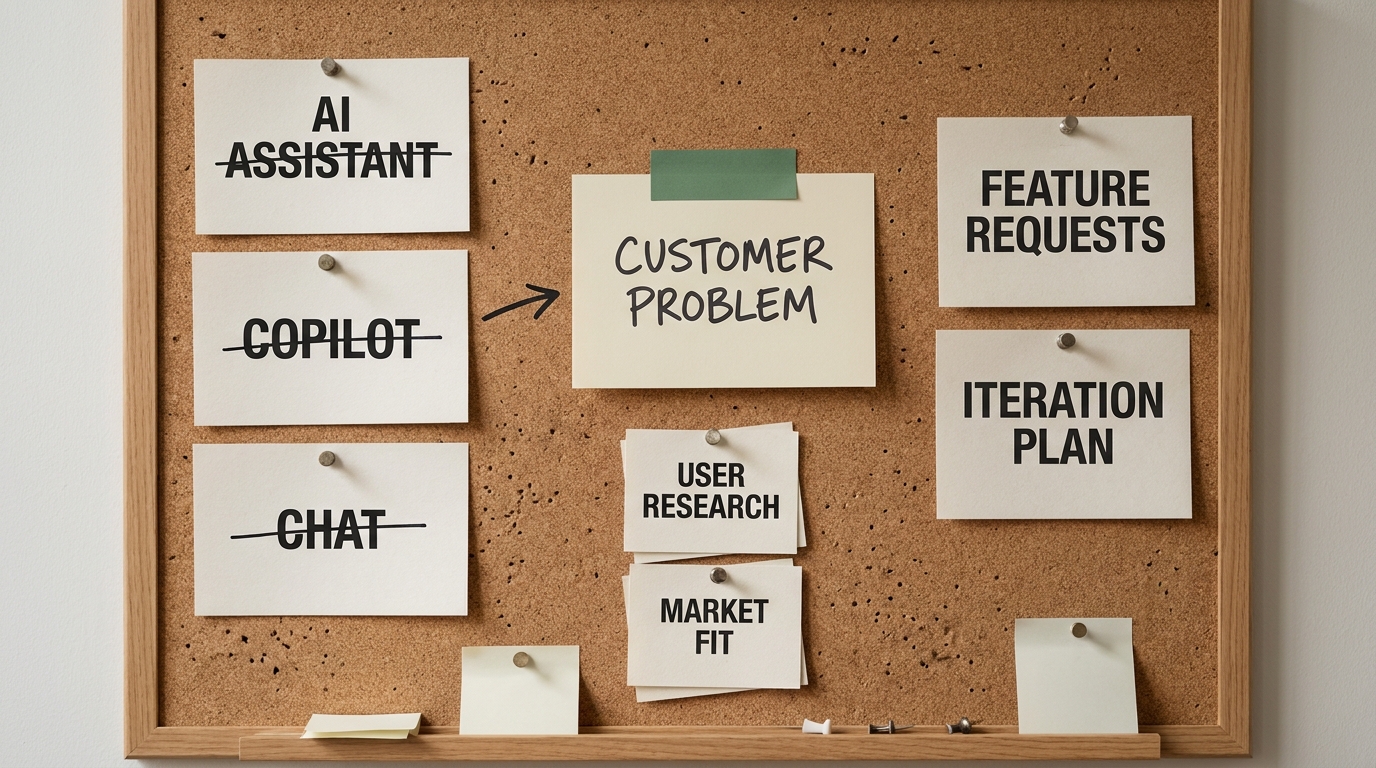

Most companies now have AI somewhere in the building. A chatbot in support. A forecasting experiment in finance. A copilot license that a handful of engineers are quietly trialing. What most of them cannot answer is the question that actually matters: which of these efforts is moving the business, and why. Spending climbs, the experiments stay stranded, and the gap between AI activity and AI value keeps widening.
That gap has a name in boardrooms now - pilot purgatory. Plenty of motion, almost no compounding return . And the cause is rarely the technology. It is that organizations have accumulated a pile of AI projects and never built an AI strategy to connect them. This article lays out what AI strategy consulting actually is, what a real engagement delivers, the components of a strategy worth the name, and how to decide whether you need outside help at all - including the cases where you do not.
Quick answer: AI strategy consulting is advisory work that helps an organization decide where and how to apply artificial intelligence to create measurable business value. A consultant assesses readiness, prioritizes high-value use cases, designs the operating model and governance, and builds a sequenced roadmap - turning scattered AI experiments into a coordinated plan tied to business outcomes.
What is AI strategy consulting?
AI strategy consulting is the work of defining where artificial intelligence should be applied in a business, in what order, and how - so that investment produces real, measurable results instead of disconnected experiments.
Three terms get used interchangeably, and they should not be. An AI strategy is the plan: the vision, the prioritized use cases, the operating model, the governance, and the sequencing that links AI investment to business goals. An AI roadmap is the time-phased version of that plan - what gets built and adopted, in what order, across which quarters. An AI strategy consultant is the outside advisor who helps you produce both, drawing on patterns from dozens of organizations rather than learning them the slow and expensive way inside one.
In practice, the consultant does a handful of concrete things. They assess your readiness across data, technology, talent, and culture. They run a structured process to identify and prioritize use cases by value and feasibility. They design how AI work will be owned, funded, and governed. They build the roadmap. And, increasingly, they help execute the first wave so the strategy does not die as a slide deck.
That last point draws the useful line between AI strategy consulting and AI implementation work. Strategy consulting answers "what should we do, and why, in what order." Implementation - data engineering, model development, integration, MLOps - answers "how do we build and run it." The two overlap, and the best engagements connect them, but they are not the same purchase. Strategy fits when you have budget and pressure but no clear priorities. Implementation fits when priorities are already clear and you need delivery muscle .
Why AI initiatives stall without a strategy
The reason so much AI spend fails to convert into value is structural, not technical. The gap now has numbers on it. McKinsey's State of AI survey classes only about 6% of organizations as high performers that attribute more than 5% of EBIT to AI. KPMG's 2026 Global AI Pulse survey of more than 2,100 executives found that while 95% now have an AI strategy, just 8% can point to measurable ROI. Definitions differ, so the exact figure moves between studies, but the direction never does: most organizations are investing far more than they are returning.
Look closely at a stalled AI program and the same six symptoms recur:
- Disconnected pilots. Each function launches its own experiment. None share data, infrastructure, or lessons, so nothing compounds.
- No prioritization. Teams chase whatever is novel or loud rather than what is valuable and feasible. The easy demos get built. The hard, high-value problems get deferred.
- Data that is not ready. Models meet fragmented, ungoverned, or inaccessible data and quietly underperform.
- No clear ownership. When AI belongs to everyone and no one, decisions stall and accountability evaporates.
- No success metrics. With no defined target, a pilot can run forever and no one can say whether it worked.
- Governance bolted on late. Risk, compliance, and responsible-AI questions surface after launch, when they are most expensive to fix.
Good looks like the inverse of that list: a small number of prioritized use cases tied to business KPIs, shared data and platform foundations, a named owner with a budget, success metrics agreed before work starts, and governance designed in from day one. The difference is not better algorithms. It is the connective tissue that turns isolated wins into a portfolio that grows.
The core components of an AI strategy
A strategy that survives contact with reality covers seven components. Treat this as the anatomy of what a good engagement actually produces.
- Vision and business case. A plain statement of what AI is meant to achieve for this business specifically - the outcomes, the value at stake, the strategic rationale. This anchors every later decision and keeps the program from drifting into technology for its own sake.
- Use-case identification and prioritization. A structured inventory of candidate applications, scored on business value and feasibility. The output is a ranked backlog, not a wish list. Two examples make the spread concrete: automating tier-one support responses is usually high-feasibility and fast to value, while AI-driven demand forecasting is higher-value but depends on clean historical data and tighter integration. A good prioritization process tells you which to start with, and why. That inventory now has to cover agentic use cases too - Gartner expects 40% of enterprise applications to embed task-specific AI agents by the end of 2026, against under 5% in 2025 - and agents score differently, because something that acts on your systems carries integration and oversight costs a read-only model does not.
- Data and technology readiness. An honest assessment of whether your data is accessible, governed, and good enough to support the prioritized use cases, plus the platform and tooling decisions needed to close the gaps. Most AI strategies live or die here.
- Operating model, talent, and change management. How AI work will be organized - centralized, federated, or a center of excellence - who owns it, what skills you need, and how people's day-to-day work will actually change. The best model on paper fails if no one adopts it.
- Governance and responsible AI. The policies and controls for risk, bias, security, privacy, and compliance, defined before deployment rather than after an incident. In 2026 this stopped being a matter of principle and became a matter of dates. The EU's Digital Omnibus, Regulation (EU) 2026/1744, entered into force on 27 July 2026 and deferred the standalone high-risk obligations under Annex III to 2 December 2027, and the product-embedded ones under Annex I to 2 August 2028. What was not deferred is the part most companies actually touch: the Article 50 transparency duties and enforcement over general-purpose AI providers took effect on schedule on 2 August 2026. A strategy that treats governance as a later phase is planning against a calendar that has already moved.
- Roadmap and sequencing. The time-phased plan that turns the prioritized backlog into a delivery schedule - what ships first to build momentum and proof, what follows, and how foundations are laid for later scale.
- Value and ROI measurement. The framework for tracking whether the strategy is working: the leading and lagging indicators, the link from each use case to a business KPI, and the cadence for reviewing and reallocating.
These seven are not sequential boxes to tick once. They form a loop. Measurement feeds back into prioritization, governance constrains the roadmap, and readiness gaps reshape the vision. A strategy document that does not connect them is a list, not a plan.
What an AI strategy consulting engagement looks like
Most engagements move through five phases. The names vary by firm; the shape rarely does.

- Assess. A readiness assessment across data, technology, talent, culture, and existing AI activity. The output is a clear-eyed baseline: what you have, what is missing, where the real constraints sit.
- Prioritize. A facilitated process to surface, score, and rank use cases. The output is a prioritized backlog with a defensible rationale for the sequence.
- Roadmap. Turning that backlog into a phased plan with owners, dependencies, foundational investments, and rough timing. The output is the roadmap and the business case behind it.
- Pilot. Standing up the first one or two use cases as controlled pilots with defined success metrics, so the strategy earns proof before it asks for scale.
- Scale and operate. Extending what worked, retiring what did not, hardening governance, and embedding the operating model so AI becomes a capability rather than a project.
Timelines should be honest ranges, not false precision. A focused readiness assessment can take days to a few weeks. A prioritized roadmap typically lands in a few weeks. Piloting runs over weeks to a few months depending on data and integration. Scaling into genuine transformation is a multi-quarter, often multi-year, arc. Anyone promising enterprise AI transformation in a single fixed sprint is selling the demo, not the outcome.
By the end of the early phases, a buyer should expect concrete deliverables: a readiness assessment, a prioritized use-case backlog, a sequenced roadmap, a governance framework , and a business case with value estimates. If an engagement cannot point to those artifacts, it is not a strategy engagement.
If you want a fast, low-commitment read on where you stand before deciding on anything larger, get an AI Readiness Snapshot - a short, structured assessment of your data, use-case, and operating-model readiness.
What AI strategy consulting costs
Buyers are told to demand pricing transparency and then given nothing to measure it against. Published 2026 rate guides vary widely and none of them is a quote, but together they establish the shape of the market well enough to tell a reasonable proposal from an unreasonable one.
- A readiness assessment. Roughly $5,000 to $15,000 for a focused mid-market engagement running two to four weeks, less for a narrow small-business scope, and $15,000 upward once it has to span an enterprise's systems and functions.
- A strategy and roadmap engagement. Commonly $15,000 to $75,000 for a two- to eight-week study in the mid-market, covering prioritization, sequencing, and the business case behind them.
- Ongoing advisory. Fractional or retained AI leadership typically runs $5,000 to $15,000 a month. That is the model that fits when the thinking is largely done and the gap is senior capacity.
- Hourly rates. Independent and boutique consultants generally bill $150 to $500 an hour. Tier-one and Big Four practices run well above that, at day rates in the low thousands.
Two things distort the comparison. The headline fee is not the cost - internal time, platform spend, and the change work around adoption commonly add 20 to 40 percent on top, so year-one totals land higher than the contract implied. And scope is rarely comparable between proposals: a $20,000 assessment and a $60,000 one may differ mainly in how many functions they cover and whether anything gets built at the end. Ask what is excluded before comparing two numbers.
When should you hire an AI strategy consultant (and when not)?
Bringing in outside help is a judgment call, not a reflex. A few signals genuinely point toward it:
- No internal AI leadership. No one owns the AI agenda with the authority and the time to drive it.
- Stalled pilots. You have experiments but nothing scaling, and you cannot diagnose why from inside.
- Board or market pressure. Leadership needs a credible plan quickly, and the cost of moving slowly is real.
- Unclear priorities. Demand for AI exceeds your ability to sort signal from noise across functions.
- A talent or capacity gap. You know roughly what to do but lack the people to design and stand it up without pulling your best operators off their day jobs.
It is just as important to name the cases where you do not need a strategy consultant - because pretending otherwise is how trust gets lost. You can probably start in-house when you already have strong internal AI or data leadership, a clear and narrow set of priorities, a single well-understood use case to prove, or an existing strategy that simply needs disciplined execution. Hiring a strategist to confirm what you already know is an expensive way to feel reassured.
There is also a middle path between "build it all in-house" and "hire a big consultancy." The talent gap is often the real bottleneck, not the thinking. Plenty of organizations know the direction but lack senior, AI-fluent practitioners to drive design and early delivery. An embedded model - bringing in a Fractional Agentic Team that works inside your organization rather than presenting to it - can close that gap without the overhead of a full transformation contract or the lag of hiring a permanent team from scratch.
Is your data and organization actually ready?
Readiness is the question buyers ask last and should ask first. The most common reason a project stalls is not a weak model. It is that the organization was never in a position to support one, and nobody checked before the money was committed.
You can run a rough self-check before any consultant walks in the door.
- Data availability. Does the data the system needs actually exist somewhere you can reach, or is it aspirational?
- Data quality. Is it consistent, reasonably complete, and trustworthy, or riddled with duplicates, gaps, and three definitions of the same field?
- Labeling. For problems that need labeled examples, do you have them, or would you build them from scratch?
- Access. Can the people doing the work actually get to the data without a three-month permissions fight?
- A named business owner. Is there one person who owns the outcome and can decide what "good" means, or a committee that will never converge?
- Clear success metrics. Do you know the number that would tell you this worked, set before the build rather than negotiated after?
If most answers are shaky, that is not a reason to drop the idea. It is a reason to start with a readiness step rather than a full build, and to be wary of any partner willing to quote a production price before they have looked at your data.
AI strategy versus AI/ML delivery: what each one buys
Strategy and machine-learning delivery get sold under overlapping labels, and the difference decides what you end up owning.
AI strategy consulting produces the decisions: which use cases, in what order, on what data, with which success metric, and what has to change in the operating model. The deliverable is a sequenced plan someone can execute.
AI/ML consulting produces the system: data pipelines, feature engineering, model selection and training, evaluation, and the deployment path. The deliverable is something running.
Buying only the first leaves you with a plan nobody builds. Buying only the second gets you a working version of whatever someone assumed you wanted. The phases that matter in an ML engagement each have their own artifact — a readiness and data assessment, a scoped use-case definition with a success metric, a prototype evaluated against that metric, then a production build with monitoring — and a partner who cannot name the deliverable from each phase is describing a hope rather than a process.
In-house build, consulting partner, or freelance hire
Three delivery models, and the right answer depends less on budget than on what you need to be left with.
In-house makes sense when the capability is core to your product and you will keep building on it for years. It is the slowest to start: senior ML hiring runs months, and one hire is rarely enough to cover data engineering, modeling, and operations.
A consulting partner makes sense when you need the first systems shipped and the knowledge transferred. The thing to check is whether the engagement ends with your team able to operate what was built, or with a dependency.
A freelance hire makes sense for a bounded, well-specified piece of work. It is the wrong shape for anything requiring several disciplines at once, and it concentrates key-person risk in a way that becomes obvious the first time the freelancer is unavailable.
Firm tier is a separate axis from all three. The global strategy houses and the Big Four bring pattern breadth and the capacity to staff a multi-country program, and they price accordingly. Boutiques and specialist firms bring senior people who stay on the work rather than rotating off it once the engagement is sold, which on a first engagement usually matters more than the length of the reference list. The question worth asking is not which tier is better but who will actually be in the room after the pitch.
What changes after launch: maintaining a model in production
Launch is a milestone, not a finish line. A model in production lives in a moving world: customer behavior shifts, upstream pipelines change, the categories the model learned drift out from under it. That is model drift, and it is not a bug. It is the default fate of every deployed model nobody maintains.
Industrializing machine learning means building the layer that keeps the system honest over time. Monitoring watches inputs and outputs for signs it is slipping. Alerting tells someone before a quiet failure becomes a costly one. Retraining refreshes the model on new data on a schedule or a trigger. Ownership names the person accountable for all of it, because a monitoring system nobody owns is another dashboard nobody reads.
A partner treating this as optional is handing you a liability dressed as an asset. The deliverable that protects you is the operational runbook: a plain description of how the system is watched, what the warning signs are, what to do about them, and who does it. Ask for it by name. Its absence is one of the most reliable signals that an engagement was built to impress at launch rather than to last.
How to choose an AI strategy consulting partner
This is where buyers get the least help and need it most . Vendor pages assume you will hire them; generic explainers mention partner selection in passing. Here is a concrete lens.

Evaluate candidates against criteria that actually predict outcomes:
- Domain and industry fit. Have they solved problems like yours, in contexts like yours? Generic AI fluency is not the same as understanding your operating constraints.
- Proof of delivery, not just slides. Ask for evidence of work that reached production and stayed there, not a gallery of strategy decks.
- Data and engineering depth. A partner who can only advise will hand you a roadmap you cannot execute. Look for the ability to connect strategy to delivery.
- Responsible-AI maturity. Governance, risk, and bias handling should be native to how they work, not a compliance afterthought.
- Knowledge transfer and no lock-in. The goal is to leave you more capable, not more dependent. Ask how they hand the capability back.
- Pricing transparency. Clear scope, clear deliverables, clear assumptions. Vague pricing usually signals vague accountability.
- Culture fit. They will work alongside your people under pressure. If the working relationship grates, the strategy suffers.
Bring a short list of questions to every conversation. For the vendor: How do you prioritize use cases? What does the roadmap deliverable actually contain? How do you handle data readiness and governance? How do you transfer capability to our team? Walk us through a comparable engagement and what happened after you left. For your own team: Who will own this internally? What decisions are we ready to make? What does success look like in twelve months?
Finally, watch for red flags. Strategy with no credible path to execution. Hype and ambition with no metrics or measurement plan. A one-size-fits-all roadmap that could have been written for any company. Pressure to commit to a large transformation before any readiness work has been done. The right partner will be comfortable telling you what you do not need.
Measuring ROI from AI strategy
The hardest question a buyer asks is also the fairest: how will we know this paid off. The honest answer is that ROI on AI strategy is real but rarely instant, and a good strategy front-loads the measurement that makes it provable.
Strong programs track two kinds of signal. Leading indicators show early movement - adoption rates, cycle-time reductions, model accuracy, the share of a process AI now handles. Lagging indicators show business impact - cost reduced, revenue influenced, margin improved, risk avoided. Each prioritized use case should map to a specific business KPI before work begins, so value is measured against a target rather than rationalized after the fact. The value-at-stake framing - estimating the realistic financial upside of a use case during prioritization - is what lets you compare options honestly and defend the sequence.
ROI is genuinely hard early, because foundational work - data readiness, platform investment, governance - shows cost before it shows return. That is exactly why measurement belongs in the strategy from day one rather than being reconstructed later. Resist the temptation to invent precise returns. Use ranges, label assumptions, report against the KPIs you set. A partner who promises a specific ROI multiple before understanding your data is guessing.
If you want to pressure-test the value case for your highest-priority use cases with people who have done it before, an AI Transformation Discovery sprint is a structured way to move from "AI sounds valuable" to "here is the quantified case."
Common mistakes that derail AI strategies
Most failed strategies fail in predictable ways. Knowing the pattern is half the defense.
- Technology-first instead of business-first. Starting from "what can this model do" rather than "what does the business need" produces impressive pilots that solve no real problem.
- Boiling the ocean. Trying to transform everything at once spreads attention thin and delivers nothing convincingly. Sequencing exists for a reason.
- Ignoring data readiness. Treating data as a detail to handle later is the single most common cause of stalled models.
- No change management. A technically successful pilot that no one adopts is still a failed pilot. People and process are not afterthoughts.
- Governance as an afterthought. Retrofitting risk and compliance controls after deployment is slower, costlier, and riskier than designing them in.
- No measurement. Without defined metrics, you cannot tell success from activity, and you cannot defend the next round of investment.
Each of these is a discipline a real strategy enforces. That is the quiet value of strategy work: not a clever idea, but the structure that keeps obvious mistakes from happening on your budget.
Key takeaways
- AI strategy consulting connects scattered AI experiments into a prioritized, governed, measurable plan tied to business outcomes - the antidote to pilot purgatory.
- A real AI strategy covers seven components: vision and business case, use-case prioritization, data and technology readiness, operating model and talent, governance and responsible AI, roadmap and sequencing, and ROI measurement.
- A typical engagement moves through assess, prioritize, roadmap, pilot, and scale - and should produce concrete deliverables, not just advice. Timelines are honest ranges, not fixed sprints.
- You need outside help most when you lack internal AI leadership, pilots are stalling, or priorities are unclear - and you may not need it at all if you have strong leadership and a clear, narrow plan.
- Choose a partner on proof of delivery, data and engineering depth, responsible-AI maturity, knowledge transfer, and pricing transparency - and treat a strategy with no path to execution as a red flag.
- Published 2026 ranges put a mid-market readiness assessment near $5,000-$15,000, and a strategy and roadmap engagement near $15,000-$75,000, before the internal time, platform, and change costs that typically add 20 to 40 percent on top.
Strategy before pilots is not bureaucratic caution. It is the difference between AI as a line item and AI as a capability that compounds. If you are weighing whether to bring in help - or just want a clear read on where you stand - start with an AI Readiness Snapshot and decide from there.
- Check readiness before scope: data availability and quality, labeling, access, a named business owner, and a success metric set in advance. Shaky answers argue for a readiness step, not a full build.
- Strategy buys decisions; AI/ML delivery buys a running system. Buying one without the other leaves you with either a plan nobody builds or a working version of the wrong thing.
- A deployed model decays by default. Monitoring, alerting, retraining, and a named owner are the difference between an asset and a liability, and the operational runbook is the deliverable to ask for by name.