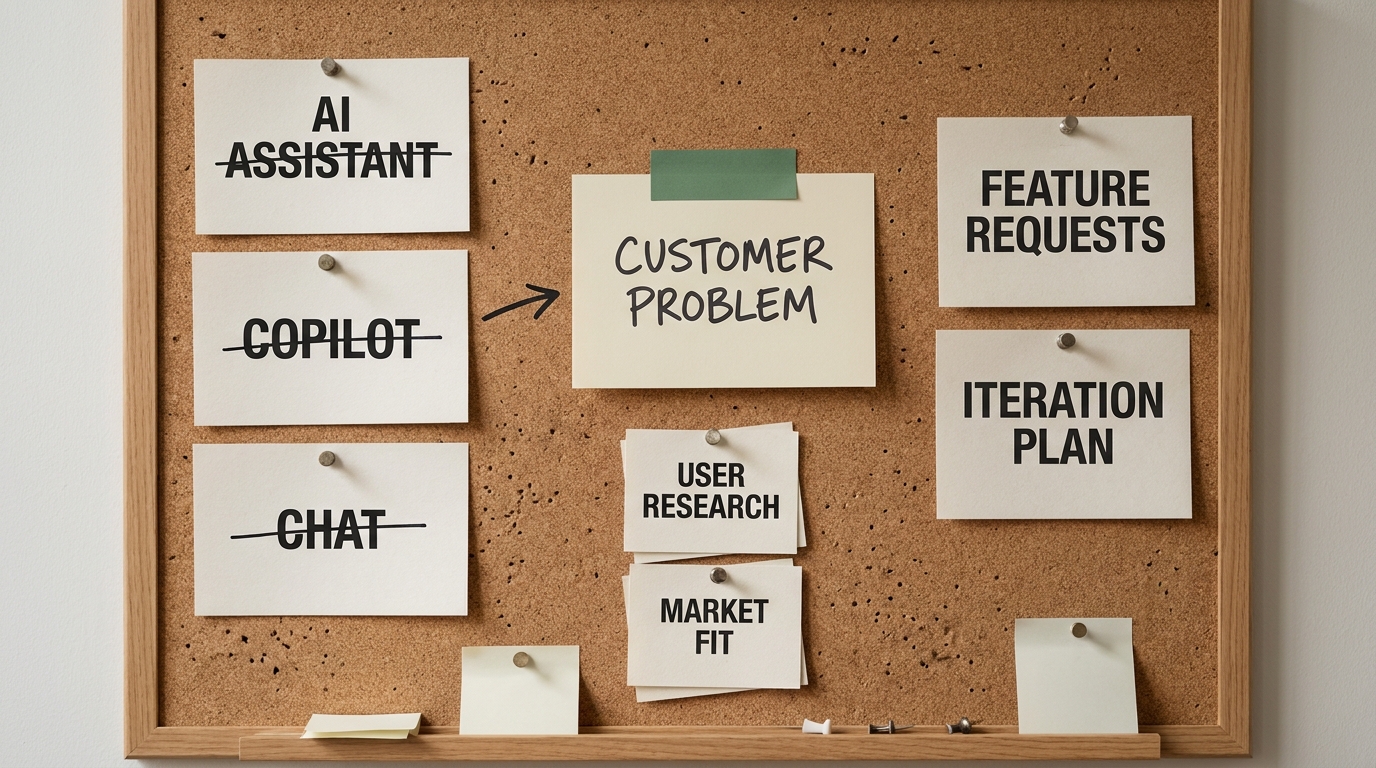

A mid-market COO sat across from us last quarter and said the quiet part out loud: "We need AI in operations, but every consultancy that walks in the door quotes us a number we'd use to pay for half a finance team. So we keep doing nothing."
That hesitation is now the most expensive line item on her P&L — and it's also the wrong one. The cost of AI consulting services has fallen sharply for mid-market companies ($10M-$1B revenue, 100-5000 employees), because AI-enabled delivery has compressed what used to be twelve-month engagements into ten-week sprints. This piece is for the operating leader who needs to decide what to buy, when to buy it, and how to know it worked — without paying Fortune 500 prices for advice that ends in a deck.
Quick answer: what are AI consulting services for the mid-market?
AI consulting services help a company use artificial intelligence to displace routine work, lift output quality, and ship operational software faster than its in-house team could alone. For mid-market buyers specifically, the offer has changed. A practitioner-led firm now combines three things in a single engagement: an assessment of where AI moves the P&L, working software shipped into production, and an enablement layer so internal teams can run the system after handover. Affordability comes from AI-enabled engineering — the same productivity gains the consultancy is selling, applied to the consultancy's own delivery cost. A ten-week sprint at this shape now costs roughly what a Big-4 strategy assessment used to, with a working system at the end instead of a recommendation.
What is included in modern AI consulting services?
The shape has shifted. Five years ago, AI consulting meant a strategy deck and a vendor shortlist. Today, a practitioner-led engagement bundles four things:
- Opportunity assessment — function-by-function map of where AI displaces work, lifts quality, or absorbs growth without new headcount.
- Architecture and selection — build-vs-buy decisions, model selection, eval design, integration plan with the systems you already run.
- Build and ship — the consultancy's engineers deliver working software into production, not into a slide.
- Enable and measure — internal team trained to operate, extend, and govern the system; baseline + post-launch metrics agreed in advance.
The buyer test for whether you're talking to a real AI consulting firm versus a strategy shop is simple: ask who writes the production code. If the answer is "we'll recommend a partner," you're paying a finder's fee. If the answer is "our engineers, embedded with your team," you're buying delivery.
Definition box: AI consulting services in the mid-market context
- Buyer: COO, CFO, CHRO, VP of Operations, VP Customer Success, Chief Transformation Officer
- Company size: $10M-$1B revenue, 100-5000 employees
- Typical duration: 10-16 weeks per use case
- Output: Production software + measurement plan + trained internal owner
- Not the same as: Strategy assessment, RPA-only automation, single-tool implementation
- Pricing shape: Fixed-scope sprint or outcome-tied engagement, not staffing-by-the-hour
How do AI consulting services actually work? A four-stage framework
Below is the stage map most practitioner-led consultancies converge on, with rough effort split. Names vary; the shape doesn't.

Stage 1: Assess
The assessment phase finds the real opportunities and rules out the bad ones. A good assessment produces:
- A ranked list of candidate use cases with estimated effort and P&L impact
- Build-vs-buy recommendations for each
- A baseline of current-state metrics (cycle time, cost per transaction, accuracy, throughput)
- A clear "what success looks like" statement signed by the operational owner
- A short list of disqualifying risks for each use case (data gaps, regulatory exposure, change-management readiness)
This stage usually runs two to four weeks. Expect interviews with frontline staff, a process walkthrough, and a data audit . Skip the data audit and you're guessing.
Stage 2: Architect
Architecture turns the chosen use case into a buildable plan:
- Reference architecture (which models, which orchestration, which retrieval pattern, which evals)
- Integration plan with the systems of record already in place
- Eval design: how the system will be tested before launch and continuously after
- Guardrail design: what the system will refuse to do, and how that refusal is logged
- Owner sign-off on the metric that will move
Architecture is where weak engagements quietly fail. If the consultancy can't draw the eval gate on a whiteboard, you're buying a demo, not a system.
Stage 3: Ship
The build phase is where AI-enabled delivery shows up. The consultancy's engineers — using AI assistance themselves — write, review, and ship the system:
- Sprints in two-week increments with a working artifact at each review
- Integrated continuously into your environment, not into a sandbox
- Eval suite running on every change before merge
- Frontline operators looped in for usability checks weekly, not at the end
- Documentation written as the system is built, not retrofitted
GitHub's own research on AI-assisted programming reports a 55% improvement in task-completion speed on controlled tasks for engineers using Copilot ( GitHub Research ). That gain — applied across the consultancy's engineers — is the reason a fixed-scope sprint now prices the way it does.
Stage 4: Enable
The handover stage decides whether the system survives without the consultancy:
- Two to four named internal owners trained on operate-and-extend tasks
- Runbook for incidents, drift, model upgrades, and eval regressions
- Monthly review cadence locked in for the first quarter post-launch
- Clear extension backlog so the next ten use cases don't need a new engagement
Skipping enablement is the most expensive false economy in AI consulting. A system without an internal owner is one that drifts, breaks, and gets ripped out within twelve months.
What is the difference between AI consulting and AI implementation?
These two terms get used interchangeably, and the blur is expensive. Knowing the difference is the first filter when you compare firms, because it tells you exactly what you are paying for: a decision, a system, or both.
AI consulting is the broader activity. It covers the thinking work: where to apply AI, whether your data is ready, what the business case looks like, and how to sequence a program. A consulting-only engagement can end with a roadmap and no code. That is fine when you have a strong internal build team that only needed direction. It is a trap when you assumed the deck came with delivery and it did not.
AI implementation is the building work: the model, the pipelines, the integration, the deployment. An implementation-only engagement assumes someone else already decided what to build, and that the decision was correct. When the underlying strategy was thin, implementation just gets you to a working version of the wrong thing faster.
The failure pattern is predictable. The two get split across vendors, the strategy firm hands over a deck, the implementation shop reads it differently, and the seams between them are exactly where projects stall. Each side can honestly say it did its job while the outcome never arrives. Keeping strategy and build on one senior team removes that handoff, which is where momentum dies and accountability quietly evaporates.
Why has AI consulting become affordable for mid-market companies?
Three forces compressed the price.
- AI-enabled engineering. The same gains the consultancy is selling — code completion, automated test generation, AI-assisted review — apply to the consultancy's own delivery. Internal data from our parent group Ascendix shows 150 engineers reached 85% sustained AI adoption over 18 months. That productivity passes through into client pricing.
- Better building blocks. Foundation models, vector stores, and orchestration frameworks are commodity now. A consultancy doesn't have to build a retrieval pipeline from scratch — the work is selection, evaluation, and integration.
- Tighter scope. Mid-market engagements are scoped to a single high-impact use case, not a multi-year program. Tighter scope means tighter cost.
The combined effect: a ten-week production sprint now costs roughly what a Big-4 strategy assessment used to. The deliverable is different — a working system instead of a recommendation — but the buyer's outlay is comparable. Affordability stops being the blocker.
Three reasons mid-market consulting was previously too expensive
- Engagements were modeled on enterprise scope (year-long programs)
- Delivery teams were not AI-native, so build cost matched 2018 productivity
- Strategy shops priced advice, not outcomes — meaning the buyer paid twice (advice + implementation partner)
Three reasons that has changed in 2026
- Practitioner-led firms ship production software, not slide decks
- AI-enabled engineering compresses build hours by a measurable margin
- Fixed-scope sprints replace open-ended retainers for most use cases
When should a mid-market company hire AI consulting services?
Readiness is not about technology. It's about whether you have:
- An operational owner with budget authority and a clear pain
- A measurable baseline (current cycle time, current cost per transaction, current accuracy)
- A use case with sufficient volume to justify the build (rule of thumb: any process touched ≥500 times per month is a candidate)
- Reasonably clean data — or willingness to fix the data before launch
- Political air cover from at least one C-level sponsor
- A willingness to put a frontline team in the room with the consultancy weekly
If you have all six, you're ready. If you have four, you can start with an assessment and build the missing two during the engagement. If you have two or fewer, hire an internal AI lead first; consulting won't fix readiness.
Five signs you are NOT ready
- No one can name the single metric the project will move
- The use case is "explore AI in our company" with no specific function
- Data lives in seven systems with no system of record
- The CEO bought it, but no operating owner has signed up
- Procurement is treating it like a software purchase ("send us your security questionnaire")
Five signs you ARE ready
- The owner says "I want to cut our customer-support first response time from X to Y by Q3"
- Baseline metrics are already reported monthly
- The team has tried at least one AI tool in production (even a small one)
- There is a budget line for the engagement, not a "we'll figure it out" plan
- Leadership has set a definition of success in writing
What measurable outcomes should mid-market AI consulting deliver?
Outcome-anchored engagements move at least one metric in the buyer's existing operating dashboard. Specific examples by function:
- Customer support — first response time, ticket deflection rate, cost per ticket, CSAT
- Sales operations — lead-to-MQL conversion, time-to-quote, pipeline forecast accuracy
- Marketing — content production cost per asset, campaign cycle time, organic-traffic compounding
- Finance — close-cycle days, AP cost per invoice, anomaly-detection rate
- HR — time-to-fill, employee-helpdesk first-response time, policy-question deflection rate
- Operations — invoice processing throughput, contract-review cycle time, exception rate
- Supply chain — forecast accuracy, supplier-risk lead time, demand-signal latency
- Compliance — contract-clause coverage rate, regulatory-update response time, audit-prep hours
If the engagement does not move at least one of these, ask why. A consulting engagement that produces a "platform" without a metric to move is the slow version of a failed project.
What "good" looks like — sample outcomes (illustrative ranges from third-party research)
- Customer support tier-1 deflection — Baseline (typical): 0-10% — After (typical): 40-60% — Source: AllAboutAI customer-service stats
- First response time — Baseline (typical): 12 hours — After (typical): <30 minutes
- Cost per support interaction — Baseline (typical): $4.60 — After (typical): $1.45
Each row is a typical pattern from research aggregators. None of these are commitments. The point of citing them is to set the shape of the upside, not to make a numerical promise.
How does mid-market AI consulting differ from Big-4 strategy work?
The two services are built for different buyers, even when they share the words "AI" and "consulting."
- Primary deliverable — Big-4 / strategy shop: Strategy deck + roadmap — Practitioner-led mid-market AI consulting: Production software + measurement plan
- Engagement length — Big-4 / strategy shop: 6-18 months — Practitioner-led mid-market AI consulting: 8-16 weeks per use case
- Pricing shape — Big-4 / strategy shop: Time-and-materials, six-figure floor — Practitioner-led mid-market AI consulting: Fixed-scope sprint, mid-five to low-six figures
- Implementation — Big-4 / strategy shop: Subcontracted to a partner — Practitioner-led mid-market AI consulting: In-house engineers ship the system
- Buyer — Big-4 / strategy shop: CEO / Board sponsor — Practitioner-led mid-market AI consulting: Operational owner + C-level sponsor
- Risk model — Big-4 / strategy shop: Recommendation passes risk to client — Practitioner-led mid-market AI consulting: Outcome-tied engagement keeps risk on the consultancy
Neither model is wrong. Big-4 is the right call for a Fortune 500 considering a five-year operating-model rebuild. Mid-market needs the second model — the one that ends with a system in production, not a roadmap for one.
What does customer support tier-1 deflection look like in practice?
A SaaS company with about 1,500 employees was running a 22-person support team. Tickets were growing 30% year-over-year. Hiring 7 more agents would have absorbed the growth, but the COO didn't want a 30-person team — she wanted a 22-person team handling a doubled volume .

What an engagement of this shape typically does:
- Assessment finds that 56% of tier-1 tickets fall into 14 recurring intents
- Architecture proposes a retrieval-augmented agent answering the 14 intents, with a human-handoff rule for anything outside that set
- Build phase ships the agent integrated with the existing helpdesk in 8 weeks
- Eval gate requires 92% accuracy on the held-out test set before any live traffic
- Enablement trains two existing senior agents as system owners; they tune intents weekly
Typical pattern (illustrative, not a commitment):
- 40-50% of tier-1 tickets deflected within 90 days of launch
- First-response time on deflected tickets drops from 8 hours to under 2 minutes
- Human agents shift to harder tickets, with reported satisfaction lift
- Operating cost per support interaction drops by roughly half
- Net cost-of-engagement payback in 7-10 months at the company's volume
The gain is not the agent. The gain is the team operating at double volume with the same headcount.
What does AP invoice processing look like in practice?
A regional industrial distributor with about 800 employees was processing 14,000 invoices a month across three ERPs and four vendor portals. The AP team was four people. Two were full-time on data entry. Closing each month took eleven business days.

What the engagement typically does:
- Assessment maps the invoice flow and identifies the 11 fields that drive 95% of routing decisions
- Architecture proposes an extraction + validation system, with confidence-scored routing and a human queue for low-confidence cases
- Build phase ships the system in 10 weeks, integrated with the existing ERPs
- Eval gate: extraction accuracy ≥98% on the validation set; field-level precision ≥95%
- Enablement: AP lead becomes the system owner; weekly drift review
Typical pattern (illustrative, not a commitment):
- 85% of invoices auto-routed without human touch
- Two FTEs reallocated from data entry to vendor management and exception handling
- Close cycle drops from 11 to 7 business days
- Anomaly checks catch duplicate invoices missed in the prior baseline
- Engagement cost paid back inside the first fiscal year
What the team actually gets back is judgement time. The data-entry hours weren't the value. The vendor-management hours those people now spend are.
What pricing shape should you expect from AI consulting services?
Three engagement shapes dominate the mid-market today. Pick the one that matches the maturity of your problem.
Shape 1: Assessment
- Duration: 2-4 weeks
- Output: prioritized roadmap, build-vs-buy recommendations, ROI estimates per use case
- Right for: company with no AI foothold, multiple candidate use cases, no clear starting point
- Pricing: low-five to mid-five figures (illustrative range)
Shape 2: Production sprint
- Duration: 8-16 weeks per use case
- Output: working system in production, eval suite, runbook, trained internal owner
- Right for: company with a single high-priority use case and a clear operational owner
- Pricing: mid-five to low-six figures (illustrative range)
Shape 3: Embedded transformation
- Duration: 6-12 months
- Output: 3-5 use cases shipped sequentially, an internal AI capability stood up
- Right for: company committing to AI as an operating-model change, not a single project
- Pricing: low-six to mid-six figures, milestone-based (illustrative range)
Avoid time-and-materials billing without a fixed scope. T&M is the consultancy keeping the upside; fixed scope keeps the upside with you.
What engagement models and timelines should you expect?
Timelines vary with scope, and any firm quoting fake precision before seeing your data is guessing. What you should expect from a serious partner is clear ranges and small first commitments, not one large number attached to a vague promise. Three shapes cover most of the market.
- Readiness check. Half an hour, free. For any team unsure whether AI is ready to help at all. No procurement process to start.
- Discovery sprint. About one week, fixed scope and fixed price. For teams ready to plan a real build. You leave with a costed roadmap you can take to your own leadership, and hand to any firm you like.
- Build and operate. Ongoing, typically billed monthly. For teams with a prioritized use case that needs shipping and running. Duration and cost scale with the system rather than a fixed multi-year contract.
The structure is deliberate. Each step is short and self-contained, so you decide whether to continue with real information instead of a long upfront commitment. A first working build often lands in weeks rather than quarters, because a discovery sprint scopes something achievable rather than trying to boil the ocean. Smaller first wins also build internal confidence, which matters as much as the technical result when you are asking a skeptical organization to back AI again after a previous miss.
The monthly operate model exists for a specific reason. AI systems are not static software. Data shifts, user behavior changes, and a model that was accurate at launch will drift if nobody tends it. Paying for operation as an ongoing service, rather than treating it as a one-time project cost, is what keeps the system earning its keep instead of decaying into something your team quietly stops trusting.
How do you measure ROI from an AI consulting engagement?
ROI on AI work splits into four components. Track all four; one alone is misleading.
- Direct cost displacement — hours, FTEs, or external spend that the system removes
- Throughput gain — increased volume the existing team handles after launch
- Quality lift — fewer errors, lower rework, higher CSAT, fewer compliance escapes
- Optionality value — the next use case becomes cheaper because the platform, evals, and team are in place
A serious engagement will give you a baseline for at least the first three before any code is written, and a measurement plan that re-checks each quarter for the first year.
Eight ROI questions to ask before signing an engagement
- What is the current baseline metric we will move?
- Who in our company owns that metric today?
- How will we measure post-launch?
- At what point in the build does the eval gate engage?
- What happens if the system fails the eval at launch?
- How is drift detected after handover?
- What does the model cost per transaction in production?
- Who pays if a model upgrade breaks the eval?
If the consultancy hasn't thought about questions five through eight, the engagement is under-scoped.
Why do most AI projects fail before production?
The failure rate is the reason this market exists, and the causes are boringly consistent. Organizations hit the same wall, usually without recognizing what they ran into.
- Data that is not ready. Models trained on incomplete, inconsistent, or siloed data produce unreliable output no amount of model selection fixes. This is the single most common root cause.
- No business case. A project launched because AI was on the agenda has no measurable target, so nobody can say afterwards whether it worked.
- No owner. When the workflow the AI touches has no accountable owner, decisions stall and exceptions pile up unresolved.
- No production path. A pilot built in isolation has no integration, no monitoring, no security review, and no plan for who runs it. It works in the demo and dies on the way to live traffic.
- No enablement. A system handed over without training the people who must operate it gets quietly abandoned within a quarter.
A consulting engagement earns its fee by attacking these before the model, not after. That ordering is the whole difference between a project that ships and one that joins the pilot graveyard.
Who are AI consulting services right for, and who should skip them?
Honest qualification matters more than reach. A service that claims to fit everyone usually fits nobody well.
A good fit: mid-market companies scaling AI past a first experiment into core operations, where a stalled project has a visible cost. Startups past prototype that need production-grade engineering without diverting a small team onto MLOps. Teams with a genuine AI talent or capacity gap who need senior delivery now and cannot wait two quarters to hire it. Leaders burned by a stalled pilot who want a partner accountable for outcomes rather than advice.
A poor fit: teams that want a strategy deck with no intention to build, since there are excellent strategy houses and a delivery firm is not the cheapest way to buy a presentation. Organizations looking for staff augmentation, meaning individual bodies to direct rather than a team that owns delivery end to end. Companies with no business problem in mind, hoping a consultant will manufacture a reason to adopt AI. AI should serve a goal you already have, not invent one.
If you sit in the second column, a different kind of provider will serve you better, and a good firm will say so on the first call.
What are the common anti-patterns in mid-market AI consulting?
Three failure shapes recur across mid-market AI projects. Each has a tell at the contracting stage.
Anti-pattern 1: The platform without a use case
The consultancy proposes a "platform" or "AI capability" with no specific metric to move. Six months in, there is infrastructure but nothing in production. Tell at contracting stage: the deliverable is named in nouns ("a vector database, a model gateway, a chat interface") rather than in verb-outcomes ("cut first response time from X to Y").
How to avoid:
- Insist that every phase has a metric attached
- Refuse to fund infrastructure that isn't directly required by a use case in production within 90 days
- Make the operational owner — not IT — the engagement sign-off
Anti-pattern 2: The model demo dressed as a system
A working demo gets shown at the end of the engagement. It impresses the steering committee. It is never integrated, never evaluated against production traffic, and quietly disappears. Tell at contracting stage: no eval gate, no integration plan, no runbook line items in the SOW.
How to avoid:
- Eval suite written and signed off before any model is selected
- Integration into systems of record on day one, not after demo
- A go-live milestone with hard criteria, not a "we'll launch when it's ready"
Anti-pattern 3: The build with no enablement
The consultancy ships a working system, hands it over, and disappears. Six months later the system has drifted, no one on the internal team can update it, and a model upgrade has silently broken the eval. Tell at contracting stage: the SOW does not name the internal owner.
How to avoid:
- Two to four named internal owners trained during the build, not after
- Runbook for incidents, drift, and upgrades delivered as part of the engagement
- Quarterly review cadence locked in for the first year post-launch
What questions should you ask any AI consulting firm before signing?
- Show me the last three production systems your engineers shipped, including the eval suite.
- Who, by name, will be embedded with our team for the build?
- What metric will we move, and what's our current baseline?
- What does the system cost per transaction once it's in production?
- What happens at handover — who owns this on day 91?
The answers separate practitioner-led firms from strategy shops with a partner network.
How do governance and the EU AI Act change the buying decision?
The EU AI Act's timetable moved. Under the Digital Omnibus agreed in May 2026, obligations for standalone high-risk systems were pushed to 2 December 2027, and to 2 August 2028 for high-risk AI embedded in products already covered by EU product-safety law. What did land on 2 August 2026 is the Article 50 transparency regime: disclosing that a person is dealing with an AI system and labelling synthetic content, with the watermarking duty itself given until 2 December 2026. The prohibited-practice ban has applied since February 2025 and carries the heaviest fine tier, up to EUR 35 million or 7% of worldwide annual turnover. Most other breaches cap at EUR 15 million or 3%. Governance is still financial exposure. The deadline is just further out than the date most roadmaps were built around.
Most internal IT teams do not have the legal-technical hybrid skills to audit training data for compliance, which is why demand has shifted toward engagements that build a governance framework before a model reaches production rather than after. Deploying models today without a documented governance strategy accumulates compliance debt, and that bill comes due faster than most executives expect. Gartner's projection is narrower than the version usually quoted: through 2026, organizations will abandon 60% of AI projects that are not supported by AI-ready data. The condition is the whole point. Governed, well-described, use-case-aligned data is what separates the projects that survive, which makes an audit-ready framework a structural advantage rather than a cost centre.
Why are fractional AI teams replacing full-time hires?
The biggest blocker to scaling AI is not the technology. It is the people. Deep data science expertise is a scarce resource, and mid-market companies usually lose the bidding war for it. 2026 hiring reports still put time-to-fill for a senior AI engineer at roughly 4.6 months, with fully loaded first-year cost in the $300K to $460K range before the hire ships anything. That is not a viable timeline if you need to move this year.
The market's response is the fractional model: specialists embedded directly into your workflows for defined sprints, without permanent hiring overhead. A fractional engagement typically runs 60 to 70% cheaper than a full-time equivalent and is productive within 30 days. The pairing that makes it work is external AI expertise plus your internal domain knowledge, which is also what makes agentic workflows viable, where agents handle genuinely multi-step tasks rather than single prompts.
What changes when you are buying agents, not models?
More of what mid-market buyers scope in 2026 is software that acts rather than software that answers. Gartner expects 40% of enterprise applications to include task-specific AI agents by the end of 2026, up from under 5% in 2025. That changes what belongs in the statement of work.
An agent that drafts a reply is a content problem. An agent that issues a refund, updates a record in your ERP, or emails a customer is an operations problem, and it needs controls the model-era engagements never had to specify:
- Scoped credentials — the agent holds the narrowest access that completes the task, not a shared admin account
- Reversibility — every action it can take has a defined undo, and the runbook names who performs it
- An audit trail per action rather than per conversation, so an incident review can reconstruct what the agent did and on what evidence
- A spend ceiling, because an agent that retries in a loop bills you for the loop
- Escalation that fires on low confidence before the action, not after
The scoping question follows from the list. Ask a prospective partner which actions the agent will be allowed to take unsupervised in month one, and what the rollback is for each. A firm that answers in capabilities rather than in permissions has not run one in production yet.
What three shifts separate 2026 winners from the rest?
The execution wall is a solvable problem, but only if you stop treating AI as a software purchase.
- Spending is not the same as return. Productivity gains of 20 to 45% materialize only when AI is wired into core operations, not parked in an isolated innovation lab.
- Compliance is the new moat. Organizations with documented, audit-ready frameworks hold a structural advantage over those scrambling to catch up after the fact.
- Hire slow, move fast. A fractional team builds your first agentic workflows in weeks while you work out what you actually need full-time.
The companies that win are not doing more AI. They are doing it in a more disciplined and integrated way.
Key takeaways
- AI consulting services in 2026 ship production software, not just strategy decks — for mid-market buyers, this is the only shape worth paying for.
- Affordability comes from AI-enabled delivery: the same productivity the consultancy is selling, applied to its own engineering cost.
- A serious engagement bundles four stages — assess, architect, ship, enable. Skipping enable is the most expensive false economy.
- Readiness is operational, not technical: a named owner, a baseline metric, sufficient volume, and decent data.
- Outcome-anchored engagements move a metric on your existing operating dashboard. If the engagement doesn't, ask why.
- Pick the engagement shape that matches your maturity: assessment, production sprint, or embedded transformation.
- Measure ROI in four parts — direct cost, throughput, quality, and optionality. Track all four.
- Three anti-patterns to avoid: the platform without a use case, the demo dressed as a system, the build with no enablement.
- Consulting and implementation are different purchases. Split across two vendors, the seam between them is where projects stall; one senior team owning both removes the handoff.
- The failure causes are consistent and unglamorous: data that is not ready, no business case, no owner, no production path, no enablement. A good engagement attacks those before the model.
- Governance is still a financial question, but the clock moved: high-risk obligations start 2 December 2027, while the Article 50 transparency rules applied from 2 August 2026. The 7% fine tier attaches to prohibited practices; most other breaches cap at 3%.
- A fractional team is the answer to a 4.6-month hiring cycle for senior AI engineers, typically 60 to 70% cheaper than a full-time equivalent and productive inside 30 days.
- Buying agents is not buying models. Scope the permissions, the rollback, the audit trail and the spend ceiling before any action runs unsupervised.
Next steps
If you are evaluating AI consulting services right now, start with two artifacts: (1) the metric you want to move, written in one sentence with a current baseline and a target, and (2) the operational owner who will sign for it. Bring those into the first conversation with any consultancy. Firms that engage with the metric and the owner are the ones worth your time. Firms that pivot the conversation to platforms, ecosystems, or strategic frameworks are not.
Read more about how AdvantageWorks structures these engagements in our mid-market AI transformation roadmap .